
Who Are the Best Digital Display Manufacturers in China?
China’s display supply chain is vast, but “best” depends on the job: a retail video wall, a control-room panel, and an outdoor billboard demand different strengths. Buyers should compare image quality, brightness, pixel pitch, reliability, software support, and installation experience—not just the quotation. Small details matter. A cabinet’s seams, a readable service manual, or a spare module delivered on time can shape years of operation.
The global market offers useful context. Grand View Research valued the digital signage market at USD 25.1 billion in 2022 and projected an 8.0% compound annual growth rate from 2023 to 2030. This figure covers a broad international market; it does not rank Chinese manufacturers. It does, however, underline why supplier capability deserves close scrutiny. Florian Rotberg, managing director of invidis consulting, has long argued that digital signage is a communications channel, not merely a screen. A practical paraphrase of that principle is: “Choose the display for the message and setting, not for specifications alone.” That distinction is easy to overlook.
This guide examines Chinese manufacturers through product range, customization, quality controls, certifications, export support, and real-world fit. Public specifications can look impressive. They do not always reveal how a panel performs under direct sunlight, or how quickly a supplier answers when a component fails. Those gaps deserve questions. The comparison is a starting point, not a substitute for sample testing, reference checks, and a careful review of project requirements.
What Digital Display Manufacturers in China Produce
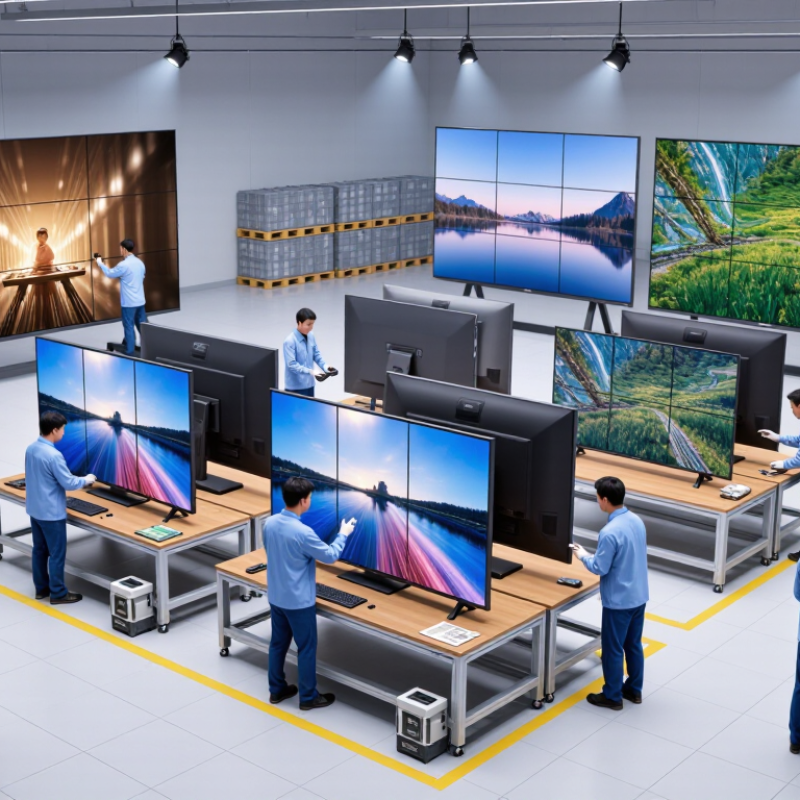
Digital display manufacturers in China produce more than screens. Their product lines often include indoor LED panels, outdoor billboards, LCD video walls, menu boards, and interactive kiosks. Some factories also make transparent LED displays for shop windows and fine-pitch panels for control rooms. The hardware may arrive as modular cabinets, with power supplies, receiving cards, cables, and mounting parts packed separately. Small details matter. A cabinet that is easy to service can save hours when a module fails above a busy entrance.
Manufacturers may also provide display controllers, playback systems, touch functions, and custom enclosures. For a retail project, a buyer might specify a 55-inch LCD screen, portrait orientation, and scheduled content playback. An outdoor installation needs different checks, including brightness, weather resistance, ventilation, and access for maintenance.
Ask for pixel pitch, refresh rate, viewing distance, and warranty terms in writing. Then test a sample under realistic lighting. It is easy to focus on resolution and miss heat, cable routing, or replacement-part availability.
I have seen specifications look complete on paper, yet leave practical questions unanswered. That is worth questioning. A supplier’s product range is useful, but consistent quality depends on materials, assembly checks, and clear after-sales support.
How to Evaluate the Best Chinese Display Manufacturers
Choosing a Chinese display manufacturer requires more than comparing quoted prices. Ask for product datasheets that specify brightness, resolution, viewing angle, and operating temperature. Then compare those figures with your actual installation conditions, such as a sunlit shop window or a bright exhibition hall. Numbers need context.
Request a sample and inspect it under realistic conditions. Check color consistency across the screen, text clarity at your expected viewing distance, and whether the casing feels secure. Ask how the manufacturer tests panels, power supplies, and complete units before shipment. A clear quality-control record is more useful than a broad promise. Check warranty terms, spare-part availability, and typical response times, preferably in writing. Small details matter.
Communication deserves a practical test. Send a specific technical question and see whether the reply addresses it directly. Ask about production capacity, lead times, and how delays are handled. If possible, speak with a recent customer in a similar industry. One imperfect sample does not prove a supplier is unreliable, but it should prompt careful follow-up. No checklist removes all uncertainty; the useful question is whether the manufacturer can explain its limits as clearly as its strengths.
| Who Are the Best Digital Display Manufacturers in China? — How to Evaluate the Best Chinese Display Manufacturers | ||||
|---|---|---|---|---|
| Evaluation Dimension | What to Check | Evidence to Request | How to Interpret It | Suggested Weight |
| Product and application fit | Display type, screen size, resolution, brightness, operating environment, mounting method, and intended duty cycle. | Datasheets, drawings, sample units, and a written specification matched to the project requirements. | Compare products against the same requirements. A suitable specification depends on whether the display is for indoor, outdoor, rental, retail, or control-room use. | 20% |
| Image performance | Brightness, contrast, viewing angle, color uniformity, refresh behavior, and performance under expected ambient light. | Test reports or sample measurements, with test conditions and measurement methods stated. | Compare like-for-like measurements. Brightness alone does not establish image quality; viewing conditions and uniformity also matter. | 15% |
| Reliability and environmental suitability | Operating-temperature range, dust and moisture protection where applicable, thermal design, and component or system testing. | Environmental and reliability test records; enclosure ingress-protection documentation when an IP rating is claimed. | Check that test conditions match the planned installation. An IP rating describes protection against ingress under specified tests; it does not by itself prove overall product reliability. | 15% |
| Quality management and compliance | Documented production controls, traceability, inspection procedures, and product safety or regulatory compliance for the destination market. | Valid quality-system certificates with scope and issuing body; applicable product test reports and declarations. | Verify certificate validity and scope. ISO 9001 is a quality-management-system standard, not a product-performance certification. Applicable product requirements vary by market and product type. | 15% |
| Manufacturing and customization capability | Capacity for the required display format, cabinet or enclosure design, control integration, and project-specific configuration. | Production-flow overview, capability statement, engineering review, and a sample or pilot build where appropriate. | Confirm which processes are performed in-house and which are outsourced. Assess capability against the actual project rather than relying on general capacity claims. | 10% |
| Testing and acceptance process | Incoming inspection, in-process checks, final inspection, burn-in if specified, and agreed acceptance criteria. | Quality-control plan, sample inspection records, and a written factory-acceptance procedure. | Acceptance criteria should be measurable and agreed before production. Test duration and procedures should reflect product design and project risk. | 10% |
| Warranty and after-sales support | Warranty terms, response process, repair or replacement arrangements, spare-parts availability, and technical documentation. | Written warranty, service-level commitments, spare-parts policy, and escalation contacts. | Compare exclusions, coverage period, shipping responsibilities, and support hours—not just the headline warranty length. | 10% |
| Commercial and delivery reliability | Quotation clarity, lead-time assumptions, packaging, shipping terms, payment milestones, and change-control process. | Itemized quotation, production schedule, packaging specification, and agreed commercial terms. | Evaluate total project cost and delivery risk, including testing, installation requirements, spares, and logistics—not unit price alone. | 5% |
| Total suggested evaluation weight | 100% | |||
Major Manufacturers and Their Areas of Specialization
China’s digital display manufacturers often specialize by product type and production capability. Some focus on fine-pitch LED walls for control rooms, studios, and large indoor venues. Others build bright outdoor screens with sealed cabinets, reinforced frames, and service access from the front or rear. These details matter: a display beside a sunny road faces different demands from one inside a meeting room.
Manufacturers serving retail and corporate spaces may offer LCD video walls, interactive panels, or integrated signage systems. Their strengths can include consistent color across multiple panels, practical mounting options, and support for content-control software. For an informed comparison, check pixel pitch, brightness, refresh rate, cabinet materials, and warranty terms. Request test results and sample images under realistic lighting. A polished demo is helpful, but it cannot show every installation challenge.
Tips: Share the screen size, viewing distance, operating hours, and indoor or outdoor conditions before requesting a quote. Ask who handles installation guidance and replacement parts. Compare written specifications, not just impressive photos. One detail is easy to overlook: confirm how technicians can reach the display after it is mounted.
Digital Display Manufacturing: Common Resolution Benchmarks
Pixel count for widely used display resolutions, calculated from each format’s horizontal and vertical pixel dimensions.
Higher resolutions require panels and display systems to handle more pixels. These figures describe standard formats, not the performance or output of any individual manufacturer.
Display Technologies and Industries Served
Chinese display manufacturers serve very different needs, from indoor LCD menus to outdoor LED walls. LCD excels at fine text, close viewing, and controlled lighting. Direct-view LED suits large venues, bright storefronts, and stadiums. OLED can deliver deep blacks and vivid contrast, but cost and burn-in risk need careful review. The fit is not always tidy. A bright panel may still look poor under reflections.
Industries shape the specification. Retail needs readable promotions and reliable daily operation. Transport hubs prioritize visibility, remote monitoring, and service access. Control rooms need fine pixel pitch for dense data, while schools and meeting spaces often favor interactive touch displays. MarketsandMarkets valued the digital signage market at US$25.2 billion in 2023 and projected US$35.9 billion by 2028 in its Digital Signage Market report. That growth points to broader adoption, not one universal display design.
Tips: Match brightness to ambient light, not showroom conditions. Check viewing distance, pixel pitch, heat, and maintenance access. Ask for operating-hour and warranty details. Test the content on the actual screen size. A specification sheet alone can mislead.
How to Choose a Manufacturer for Your Project
Choosing a digital display manufacturer starts with the conditions at your site, not a catalogue photo. Define viewing distance, screen size, operating hours, and indoor or outdoor exposure. A capable supplier should explain how pixel pitch affects image clarity at your planned distance. Ask for a sample and a written specification. Small details matter. The brightest option is not always the right one; excess brightness can make an indoor screen uncomfortable to view.
When comparing proposals, check cabinet dimensions, access for maintenance, power use, and heat management. Ask how the display performs after extended operation, and request test records relevant to your project. A sample should reveal color consistency, seams, and finish quality. It should also be tested with your actual content, if possible. Check whether the quoted delivery schedule includes inspection and packing time. Cheap quotes can omit key items.
Service matters after installation. Ask who handles technical questions, how quickly replacement parts can be supplied, and what the warranty excludes. Review the installation instructions before signing; unclear mounting or cabling details can create delays on site. A factory visit or live production walkthrough may help verify capacity, though it cannot guarantee every future delivery. No process is flawless. Compare answers in writing, and notice when a supplier admits a limitation instead of promising everything.


