
10 Best Puff Pastry Machines for Commercial Bakeries
Choosing equipment for a commercial bakery is rarely as simple as comparing prices. A reliable Puff Pastry Machine must handle laminated dough without crushing delicate layers. It should deliver consistent thickness, steady output, and clean, accessible surfaces. In a busy production room, small details matter. Dough may leave the sheeter at three millimeters, while butter softens beside the mixer. A poorly adjusted roller can tear the sheet, waste ingredients, and slow the entire team. This guide examines ten commercial options through practical criteria. We consider capacity, roller control, construction, safety features, cleaning effort, and service support. Real bakery conditions matter more than attractive catalog claims. A machine that suits one shop may not suit another.
The selected machines support bakeries producing croissants, Danish pastries, turnovers, and other laminated products. Each model deserves attention for a different reason, including compact design, automation, durability, or production speed. Operator comfort also matters, because repetitive lifting can affect accuracy and morale. Manufacturer specifications should still be verified before purchase. Voltage, belt width, warranty coverage, and replacement-part availability may vary by market. No machine is perfect. Even a strong candidate may require training, floor space, and regular maintenance. Readers should compare these findings with their dough formula, daily volume, and budget. A careful decision can protect product quality while reducing waste and unnecessary downtime. Some judgments remain subjective, especially when noise, controls, or cleaning routines influence daily satisfaction. That deserves honest reflection.
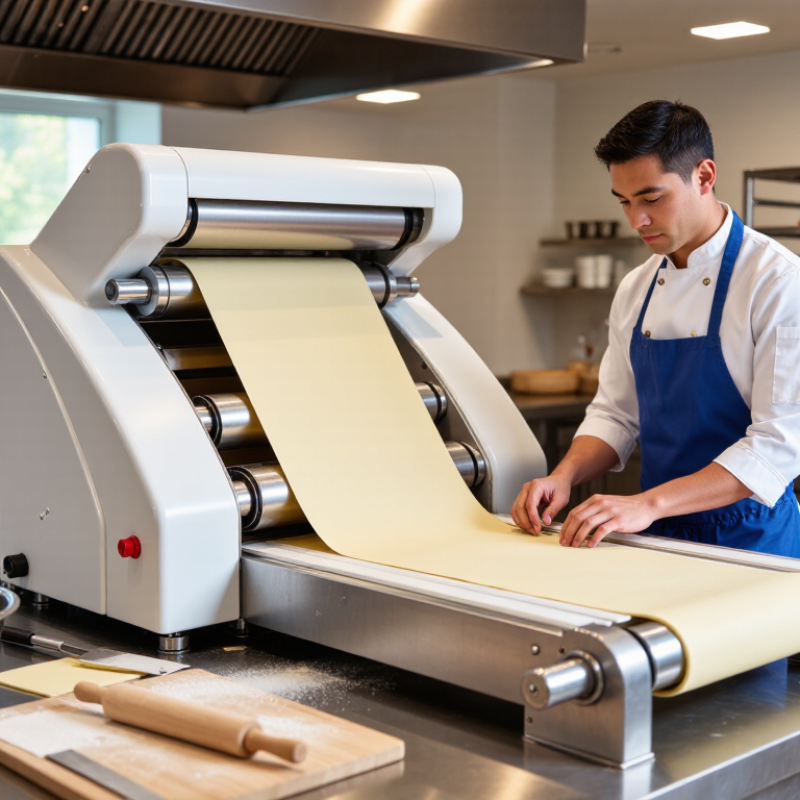
What to Evaluate in a Commercial Puff Pastry Machine
A commercial puff pastry machine must be judged beyond its advertised output. Check dough-sheeting accuracy, cutting consistency, and adjustment speed during real production. A machine should maintain even layers when dough temperature changes slightly. Ask for a trial using your own butter block and flour blend. Laboratory demonstrations can look perfect. Production rarely does.
Energy use deserves careful attention. The U.S. Department of Energy reports that industrial motor systems consume about 23% of electricity in American manufacturing. Compare motor ratings, standby consumption, and cleaning-related water use. Also inspect conveyor access, scraper removal, and guarding. The European Commission’s Best Available Techniques reference documents emphasize efficient equipment, preventive maintenance, and reduced resource waste across food manufacturing. These details affect operating costs more than a low purchase price.
Hygiene and serviceability should guide the final decision. Look for food-contact surfaces with smooth welds and minimal product traps. Confirm that operators can remove belts without special tools. Review documented changeover times, spare-part availability, and technician response in your region. PMMI industry reports repeatedly identify labor shortages and automation skills as major packaging challenges. Therefore, controls should be simple enough for quick training. I would still question touchscreen-heavy systems. Fancy controls are not always practical. Test noise, vibration, and emergency access during a full shift, not just a short demonstration.
Key Features That Affect Dough Quality and Production Efficiency
10 Best Puff Pastry Machines for Commercial Bakeries
Key Features That Affect Dough Quality and Production Efficiency
Commercial puff pastry machines must protect lamination while maintaining predictable output. The Grand View Research 2024 bakery products report estimates the global market at over USD 600 billion by 2030. That scale increases pressure on bakeries to reduce waste and improve consistency. In practice, adjustable roll gaps matter most. A gap variation of only a few millimeters can create uneven layers, weak lift, or torn dough. Servo-controlled rollers, low-friction conveyors, and accurate dough-temperature monitoring help preserve butter distribution. Hygienic stainless-steel frames also shorten cleaning time and reduce contamination risks.
Production efficiency depends on more than speed. PMMI’s 2024 manufacturing trends report identifies labor availability, downtime, and faster changeovers as major automation concerns. Look for programmable recipes, quick-release scrapers, automatic flour dusting, and synchronized cutters. These features reduce manual adjustments between product sizes. Throughput figures should be tested with your actual dough formula, not accepted from a brochure. I have seen fast machines create more scrap when the folding ratio was poorly matched. Faster is not always better.
Tips: Test a machine with chilled dough from your own recipe. Measure dough thickness across the sheet, not only at the center. Record scrap percentage, setup minutes, and recovery after stoppages. Ask for noise, energy, and washdown data. A smaller roller gap may improve layering, but it can also overwork soft dough. That trade-off deserves careful testing.
The 10 Best Puff Pastry Machines for Commercial Bakeries
Choosing the ten best puff pastry machines starts with production needs, not advertising claims. A compact tabletop sheeter suits small bakeries with limited floor space. A floor-standing sheeter handles heavier dough batches and longer working hours. Reversible sheeters reduce manual lifting during repeated folds. Continuous pastry lines support large, consistent output. They need more room and trained operators.
For laminated dough, roller precision matters. Look for adjustable gaps, steady belt movement, and stainless steel contact surfaces. A dough block should pass evenly without torn edges or crushed butter layers. Servo-controlled rollers can improve thickness accuracy, while simple mechanical controls may be easier to maintain. Cutting stations, flour dusters, and cooling conveyors add useful capacity. A modular line often gives better flexibility than one oversized machine. I prefer machines with accessible belts and removable guards. Cleaning should not require half a shift.
The best ten choices include compact sheeters, reversible sheeters, floor models, automatic folding units, cutting systems, continuous lines, spiral dough feeders, pastry laminators, integrated cooling systems, and modular production lines. Each option has trade-offs. High automation can lower labor demands, but repairs may require specialist support. A smaller machine may deliver better control during recipe changes. Not perfect. Before purchasing, I would test real dough at production temperature, measure thickness after several passes, and inspect the folded layers. Manufacturers’ figures can look impressive. Your butter temperature may disagree. A machine that performs beautifully during a short demonstration might struggle after six busy hours. Reliable bakeries therefore compare sanitation time, operator safety, maintenance access, power use, and service availability before making a final decision.
Machine Comparisons by Capacity, Automation, and Bakery Size
Choosing among the 10 best puff pastry machines requires more than comparing price tags. Capacity, automation, and bakery size must match daily production. A small bakery may need a compact sheeter producing 50–150 kilograms per hour. Larger facilities often require continuous lines exceeding 500 kilograms per hour. These figures are practical purchasing ranges, not universal standards.
Grand View Research estimates the global bakery processing equipment market will grow steadily through 2030, driven partly by labor-saving automation. That trend matters when comparing manual, semi-automatic, and fully automatic pastry systems. Manual machines offer lower entry costs and easier control for changing recipes. Semi-automatic models improve thickness consistency while keeping operators involved. Fully automatic lines reduce repetitive handling, but they need trained technicians and dependable maintenance schedules.
Size matters.
For artisan bakeries, footprint, noise, and cleaning access can outweigh maximum output. Medium bakeries should examine conveyor speed, dough recovery time, and electrical load. High-volume plants need synchronized laminators, cooling sections, cutters, and computerized production records. The International Society of Bakery and Technology emphasizes process consistency as a key quality factor in commercial baking operations. Still, automation does not guarantee better pastry. Incorrect pressure or warming dough can destroy visible layers quickly.
I would test each machine with the bakery’s own butter blend and flour. That detail is often overlooked. A machine that performs well during a supplier demonstration may behave differently during a humid morning shift. Compare output per hour, waste percentage, changeover time, cleaning hours, and service response before deciding. (Grand View Research, Bakery Processing Equipment Market Report; International Society of Bakery and Technology)
10 Best Puff Pastry Machines for Commercial Bakeries - Machine Comparisons by Capacity, Automation, and Bakery Size
| Rank | Machine Type | Typical Dough Capacity | Approx. Throughput | Working Width | Automation Level | Typical Footprint | Power Requirement | Recommended Bakery Size | Best Application | Key Selection Consideration |
|---|---|---|---|---|---|---|---|---|---|---|
| 1 | Compact Tabletop Dough Sheeter | 2–8 kg per batch | 40–100 kg/hour | 300–500 mm | Manual | 0.9–1.4 m² | 0.75–1.5 kW; single-phase | Small bakeries, cafés, pastry shops | Small-batch puff pastry, Danish pastry, croissants, and pie dough | Low purchase and installation cost; production depends heavily on operator speed |
| 2 | Floor-Standing Reversible Sheeter | 5–15 kg per batch | 80–180 kg/hour | 500–650 mm | Semi-automatic | 1.8–2.8 m² | 1.5–3.0 kW; single- or three-phase | Small to medium bakeries | Regular pastry production with repeated rolling and folding cycles | Reversible belts reduce manual lifting and improve dough-sheet consistency |
| 3 | Heavy-Duty Reversible Sheeter | 10–25 kg per batch | 150–300 kg/hour | 600–700 mm | Semi-automatic | 2.5–3.8 m² | 2.2–4.0 kW; usually three-phase | Medium-sized production bakeries | Daily laminated-dough production and medium-volume retail supply | Choose a robust frame, variable belt speed, and quick-access scraper components |
| 4 | Continuous Pastry Sheeting Line | 15–40 kg per batch | 250–500 kg/hour | 600–800 mm | Automatic | 5–10 m² | 5–10 kW; three-phase | Medium to large bakeries | Continuous production of pastry sheets for cutting, filling, and forming | Requires adequate floor space, controlled dough temperature, and upstream dough supply |
| 5 | Automatic Laminating Line | 20–60 kg per batch | 400–800 kg/hour | 600–800 mm | Fully automatic | 8–16 m² | 8–18 kW; three-phase | Large bakeries and central production kitchens | High-volume puff pastry and laminated dough with programmable reduction stages | Best for repeatable products; line layout must include cooling and transfer space |
| 6 | Puff Pastry Make-Up Line | 25–70 kg per batch | 500–1,000 kg/hour | 600–1,000 mm | Fully automatic | 12–25 m² | 12–25 kW; three-phase | Large industrial bakeries | Sheeting, cutting, filling, folding, and depositing at high production volume | Requires product-specific tooling and careful synchronization between stations |
| 7 | Croissant and Laminated Pastry Line | 20–60 kg per batch | 3,000–12,000 pieces/hour | 600–800 mm | Automatic | 10–22 m² | 10–22 kW; three-phase | Medium to large bakeries | Filled or unfilled croissants, pastry rolls, and other laminated products | Output depends on piece weight, cutting format, filling system, and proofing capacity |
| 8 | Modular Sheeting and Cutting System | 10–35 kg per batch | 200–600 kg/hour | 600–800 mm | Configurable | 5–12 m² | 5–14 kW; three-phase | Growing bakeries and contract manufacturers | Multiple pastry shapes, portion sizes, and product formats on one production platform | Useful when product mix changes frequently; confirm tooling-change time before purchase |
| 9 | Cold-Climate Laminating System | 15–50 kg per batch | 250–700 kg/hour | 600–800 mm | Automatic | 8–18 m² | 8–20 kW; three-phase | Professional bakeries with strict process control | Butter-rich puff pastry where dough and fat temperature must remain stable | Look for chilled rollers, refrigerated rest sections, and programmable dwell times |
| 10 | Custom Industrial Puff Pastry Line | 40–120 kg per batch | 800–2,000 kg/hour | 800–1,200 mm | Integrated automatic | 20–50 m² | 20–50 kW; three-phase | Industrial plants and national distribution bakeries | Large-scale production with automated dough handling, lamination, cutting, and packaging interfaces | Usually engineered to order; verify building utilities, sanitation access, and operator training needs |
Data note: Capacity, throughput, footprint, and power figures are representative commercial ranges for comparable equipment categories. Actual performance varies with dough formulation, dough temperature, reduction schedule, piece weight, operating speed, and production layout.
Cleaning, Maintenance, Safety, and Purchasing Considerations
Commercial puff pastry machines demand more than high output. During trial runs, inspect flour dust around rollers, hinge points, and guards. Dust often hides in seams. Clean the machine after every production shift, following its manual. Disconnect power before removing scrapers or belts. Never spray water near control panels, motors, or exposed wiring. A soft brush and food-safe cleaner usually protect sensitive surfaces better than aggressive chemicals.
Maintenance records should show dates, problems, adjustments, and replaced parts. Check belt tension, roller alignment, lubrication points, and emergency stops regularly. A machine that sounds different deserves attention. Do not wait for a breakdown. I have found that rushed cleaning creates more faults than heavy production. Still, inspection routines can be missed during holiday demand. That weakness needs a practical remedy: assign one trained operator and verify the checklist daily.
Purchasing decisions should include sanitation access, guarding, noise, footprint, service training, and spare-part availability. Ask suppliers for written cleaning instructions and realistic output data. Test dough handling at your own hydration and batch size. A glossy demonstration can mislead. Consider whether staff can safely lift removable parts and reach every contact surface. Energy use matters, but downtime costs more than a small efficiency gain. Choose equipment with documented safety features, clear controls, and support that remains available after installation.
Commercial Puff Pastry Machines: Maintenance and Safety Planning
This chart shows practical planning intervals commonly used for commercial puff pastry equipment. Surfaces and food-contact parts should be cleaned after each production shift, while lubrication, roller inspection, belt inspection, and electrical safety checks require less frequent attention. Always follow the machine manufacturer’s instructions and applicable food-safety regulations.


