
Best Trolley Rail Manufacturers in China for Buyers
Selecting the right Trolley Rail manufacturer in China takes more than comparing prices. Buyers need to match the rail system to its load, travel distance, operating environment, and installation method. A compact workshop trolley and a heavy-duty production line may require very different rail profiles, joints, and support spacing. Small details matter. Burrs at a joint, uneven coatings, or unclear tolerances can affect movement and maintenance over time.
This guide introduces manufacturers and practical points buyers can use when comparing their options. It considers product range, material choices, machining capability, customization, quality controls, and communication during the quotation process. These factors help reveal whether a supplier can meet a project’s actual requirements, not just provide an attractive catalogue. Ask for current technical drawings, material specifications, inspection records, and samples where appropriate. Check how the supplier handles dimensional questions and changes to an order. A polished website is not proof of consistent production. That is worth remembering. Even a promising supplier may need closer review, and published information can become outdated. Confirm critical details directly, compare like-for-like quotations, and assess whether the proposed rail fits your equipment and site conditions. The aim is not to name one universal winner, but to help buyers make a careful, evidence-based shortlist.
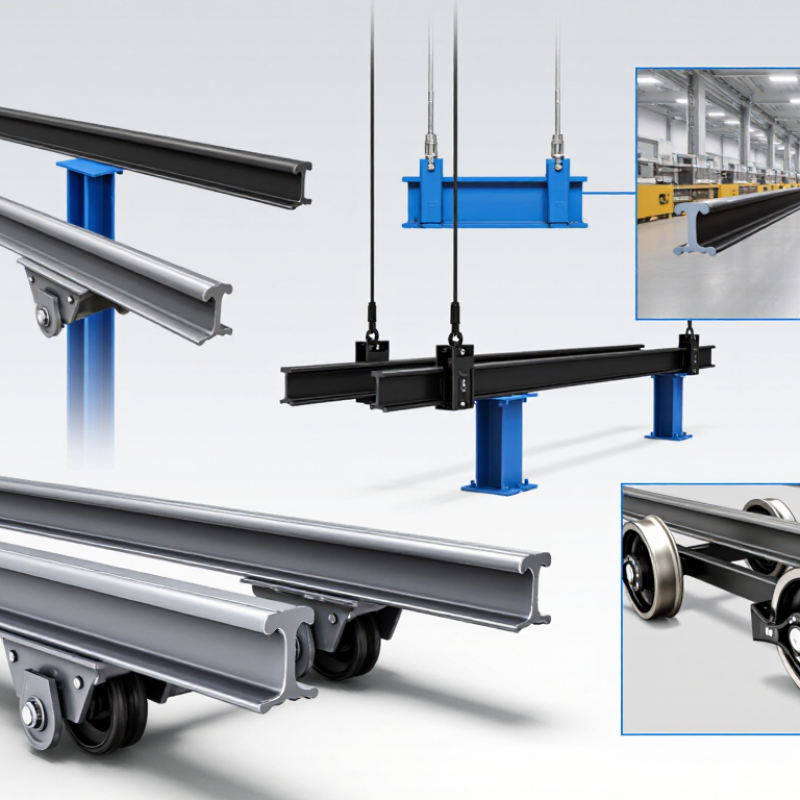
Map Trolley Rail Types to Track Layouts and Rated Loads
Choosing trolley rail starts with track geometry, not catalog photos. Straight runs with long travel may suit I-beam rail when the structure can support hangers at specified intervals. Enclosed-track rail can fit lighter-duty systems and help keep debris away from the running surfaces. Curves and switches need compatible trolleys, adequate clearance, and careful attention to load behavior. A neat diagram can still mislead.
Match the rail’s rated capacity to the heaviest intended load, including the trolley and lifting attachment. Check how many trolleys may occupy a span, and account for starts, stops, and uneven load movement. The weakest component sets the practical limit. For curved layouts, confirm ratings under the actual configuration; straight-track figures may not apply unchanged. Support spacing matters, too. A strong rail can still deflect if its hangers are too far apart or the building structure is unsuitable. Review the layout with measured spans and expected loads before ordering. That step is easy to rush. It should not be.
Apply ISO 4301-1 Duty Classes U0–U9, Q1–Q4, and A1–A8
When comparing trolley rail manufacturers in China, ask how each design maps to ISO 4301-1 duty classes. The standard defines ten utilization classes, U0–U9, four load-spectrum classes, Q1–Q4, and eight combined crane classes, A1–A8 (ISO 4301-1:2016).
U reflects operating cycles Q describes how heavily the crane is typically loaded A combines duty factors. These are not interchangeable labels. A rail for occasional, light handling may not suit repetitive shifts with near-capacity lifts. Small differences matter.
Give suppliers real operating data: lifts per hour, average load, peak load, travel distance, and expected service life. A trolley crossing a 12-meter runway every few minutes creates a different fatigue pattern from one moving twice daily. Request wheel-load calculations, rail-section details, fastening drawings, and inspection criteria against the selected duty class.
ISO 12488-1 also provides tolerances for crane tracks, useful when checking alignment and installation quality. Check the edition and project requirements.
A class alone cannot prove rail suitability; support spacing, joints, wheel geometry, and installation affect performance too. I would still verify the assumptions.
Buyers often provide peak load but overlook daily cycles, leaving an impressive-looking specification with weak foundations.
Check Chinese Manufacturers’ Rail Materials, Tolerances, and Quality Systems
When comparing Chinese trolley rail manufacturers, start with the rail’s actual duty: load, span, travel speed, and exposure to moisture or dust. A conductor rail and a structural crane rail may require different materials. Ask for the material grade, coating details, and relevant certificates. Check the finish, edges, and surface for visible pitting. Small details matter.
Tolerances should be stated on a drawing, not described only as “high precision.” Check profile dimensions, straightness, joint alignment, and hole positions where applicable. Request the inspection method and calibration records, then compare a sample with the approved drawing. A trial installation may reveal gaps that a spreadsheet misses. Skipping this check can mean costly alignment work later.
A reliable quality system links incoming materials, production batches, inspection results, and shipment records through traceable lot numbers. Ask how nonconforming sections are separated and corrected; a certificate alone cannot show the full process. Review inspection reports and, when practical, observe measurements on the production floor. Audits are only snapshots. Even careful suppliers can have variation, so define acceptance criteria and retain incoming checks. Not perfect.
Compare Supplier Capacity, Certifications, Customization, and Lead-Time Data
For trolley rail buyers, compare verified output, not factory photographs. Request monthly capacity by rail profile, material grade, and finishing process. Ask for recent production records and a sample inspection report. ISO’s 2022 Survey recorded more than 1.2 million ISO 9001 certificates worldwide, across industries. Certification is a useful process signal, not proof that a supplier can hold tight rail tolerances. Ask for evidence.
Check whether certificates cover the actual production site and relevant scope. For customization, send a drawing with rail length, section dimensions, hole spacing, load requirements, and surface finish. Request a marked-up drawing before approving a sample. Small details matter. A supplier should identify tooling charges, minimum order quantities, and what changes trigger a new validation run. Do not assume a custom rail is just a standard rail cut shorter.
Compare lead times by stage: drawing approval, sample production, batch manufacture, and dispatch. The World Bank’s 2023 Logistics Performance Index scored China 3.7 out of 5 overall; this provides country-level context, not a delivery promise from any factory. Ask suppliers for dated records from comparable orders, plus realistic buffer days. One imperfect point: buyers often compare quoted lead times without checking whether they start at deposit or drawing approval. Put the start condition in writing.
Best Trolley Rail Manufacturers in China for Buyers - Compare Supplier Capacity, Certifications, Customization, and Lead-Time Data
This comparison lists verifiable evaluation criteria rather than assigning unverified figures to unnamed suppliers. Capacity, certification status, and lead times vary by factory, product design, order quantity, and current production schedule; request current documentary evidence and a project-specific quotation before comparing suppliers.
| Comparison Area | Data to Compare | Evidence or Buyer Check |
|---|---|---|
| Production Capacity | Monthly or annual output for the specific rail type; available production capacity for the requested order; number of production lines; current utilization. | Request capacity figures in clearly stated units and for the exact product configuration. Confirm whether the stated figure is installed capacity, actual recent output, or capacity available for your order. |
| Product Specifications | Rail profile and dimensions; material and grade; rated load; trolley compatibility; straight-section and curve options; joint and suspension details. | Compare current technical drawings, material specifications, load-test results, and stated tolerances against the project requirements. Do not compare load ratings unless the test conditions and system configuration are equivalent. |
| Quality Management | Quality-management system certification and inspection controls for incoming materials, in-process production, and final inspection. | If ISO 9001 certification is claimed, verify the certificate’s validity, certification body, scope, and covered manufacturing site. A management-system certificate does not by itself certify every product. |
| Environmental and Safety Certifications | Relevant environmental or occupational health and safety management-system certifications, where required by the buyer. | Check the current validity, scope, issuing body, and site named on any claimed ISO 14001 or ISO 45001 certificate. These standards concern management systems; they are not product-performance approvals. |
| Market-Specific Compliance | Applicable product and installation requirements for the destination market, project, and intended use. | Ask for the specific standards, test reports, declarations, or approvals applicable to the quoted product. CE marking applies only when the product is within the scope of relevant EU legislation; do not treat it as a universal rail-quality certificate. |
| Customization Capability | Available options for rail length, profile, curves, joints, brackets, finishes, load requirements, packaging, and drawings. | Request a written list of standard and custom options, drawing approval steps, sample or prototype requirements, tooling charges, and any minimum order quantities. |
| Lead Time | Separate quoted timelines for drawing approval, samples or prototypes, production, inspection, and dispatch. | Obtain a dated, order-specific schedule that states the quantity, specification, start point, and assumptions. Confirm how changes, peak-season workload, and material availability affect the schedule. |
| Minimum Order and Pricing Basis | Minimum order quantity, unit-price basis, tooling or setup fees, packaging charges, and quotation validity. | Compare like-for-like specifications and quantities. Ask the supplier to identify exclusions, taxes, payment terms, shipping basis, and the validity period of the quotation. |
| Inspection and Traceability | Inspection plan, batch identification, material traceability, dimensional checks, and available load or performance testing. | Request sample inspection records and a sample certificate package. Agree on acceptance criteria, inspection timing, and responsibility for any third-party inspection before placing the order. |
| Export and Logistics Readiness | Export packaging, shipment dimensions and weight, loading method, documentation support, and proposed delivery terms. | Confirm packaging protects rail sections and accessories during transport. Request a packing list and shipment estimate based on the final order dimensions and destination. |
Verify Load-Test Records, Installation Support, Spare Parts, and Warranty Terms
When comparing trolley rail manufacturers in China, ask for load-test records tied to the exact rail profile and rated capacity. A useful report identifies the test date, load applied, test duration, and acceptance criteria. Check that the record covers joints, curves, and suspension points, not only a short straight section. Paperwork matters.
Installation support should be specific. Ask whether drawings show hanger spacing, rail alignment tolerances, and end stops. For a trial installation, confirm who checks trolley travel and clearance under load. A remote call can help, but it may not reveal a slightly twisted joint. That detail is easy to miss.
Spare parts and warranty terms deserve the same scrutiny. Request a parts list for wheels, clamps, joints, and switches, with typical lead times and compatible replacements. Read the warranty for exclusions involving corrosion, wear, or incorrect installation. Ask what evidence is needed for a claim and who pays return freight. Some supplier answers sound clear until a component fails; get the details in writing, even when the process feels tedious.


