What Is Black Rectangular Hollow Section Steel?
Black Rectangular Hollow Section steel, often called black RHS, is a hollow steel profile with four flat sides and rounded corners. “Black” usually describes its dark, uncoated mill finish, not a separate steel alloy. The surface may show oxide scale, and its appearance can vary between manufacturers and batches. Inside, the section is open and rectangular. Simple, but useful. Its shape gives fabricators a practical balance of stiffness, weight, and clean lines. You may find it in building frames, equipment bases, trailers, gates, and furniture. Yet appearance alone tells little about strength. A dark surface can look reassuring, but it is not a specification.
This guide explains how Black Rectangular Hollow Section is made, how its dimensions affect performance, and where it is commonly used. It also considers the details that matter when selecting a section, including steel grade, wall thickness, length, and applicable product standards. These details should be checked against the supplier’s documentation, not guessed from a photograph or surface finish. Load capacity depends on the application, connections, support conditions, and design. That matters. A section suitable for a light frame may be unsuitable for a heavily loaded support. The term itself can be used loosely in everyday trade, so confirming the exact product is worthwhile. Not every project needs a complex calculation, but critical structural use calls for qualified engineering advice. There is no universal “best” size; the right choice depends on the job.
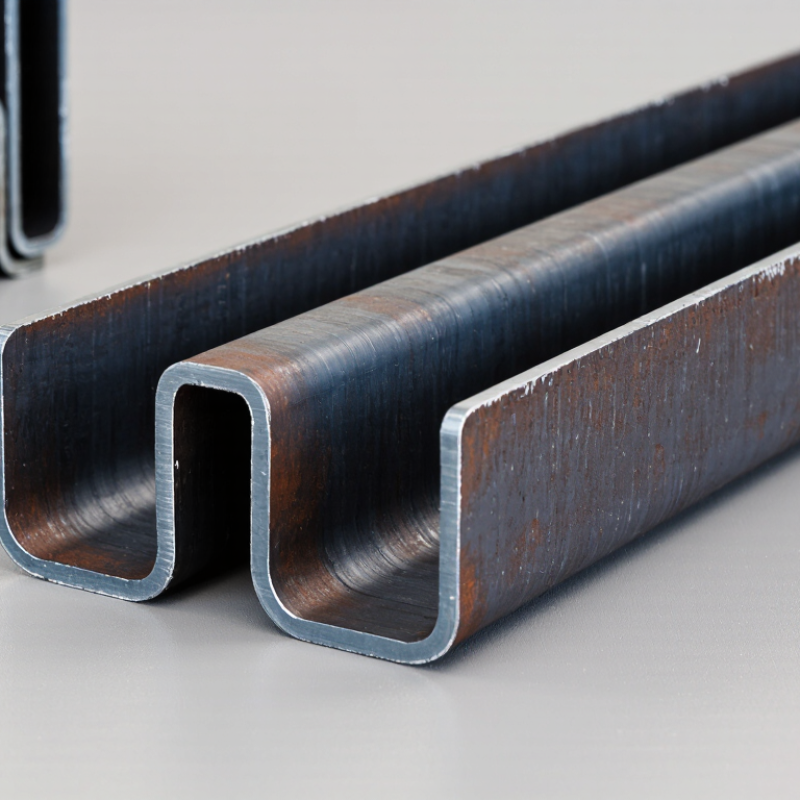
What Black RHS Steel Is: Cold-Formed, Welded Rectangular Hollow Sections
Black rectangular hollow section (RHS) steel is a closed, four-sided steel profile with a rectangular cross-section. It is typically made by cold-forming flat steel strip into shape, then welding the meeting edges along one side. “Black” usually describes its mill-scaled or untreated surface, rather than a paint or galvanized coating. Not quite a coating.
During production, rollers gradually bend the strip through successive stages. The formed section is sized, and its longitudinal seam is welded before it is cut into standard lengths. That seam matters. For inspection, look for consistent dimensions, straight sides, sound weld continuity, and damage at cut ends. A black surface may conceal light rust or handling marks, so appearance alone cannot confirm quality.
RHS is used for frames, supports, gates, and other fabricated structures where its closed shape offers useful stiffness. Actual performance depends on steel grade, section size, wall thickness, connections, and how loads are applied. Those details need checking against drawings and product documentation. One point is easy to overlook: cold-forming changes the material around the corners, while the welded seam has its own characteristics. Check specified tolerances rather than assuming every section is identical.
How RHS Dimensions Are Listed: Width × Height × Wall Thickness in Millimetres
Black rectangular hollow section steel, often shortened to RHS, has a rectangular profile with a hollow centre. Its dimensions are commonly written as width × height × wall thickness, in millimetres. A listing of 100 × 50 × 3 mm therefore describes a section 100 mm wide, 50 mm high, with 3 mm walls. The first two measurements refer to the outside faces, not the internal opening.
That distinction matters. Wall thickness reduces the available space inside the section, and corner radii also affect the clear opening. A quick estimate for a straight internal span is the outside measurement minus twice the wall thickness. It is only an estimate. For a close-fitting insert or connection, check the supplier’s dimensional data rather than relying on simple subtraction.
Orientation deserves attention, too. A 100 × 50 mm section may be installed with either face vertical, depending on the design. The written order alone may not show how it sits in a particular drawing. Check the drawing notes and keep the specified order consistent when comparing sections. The notation looks straightforward, but it is easy to swap width and height when reading a hurried parts list. When accuracy matters, verify all three figures before cutting.
Steel Grades and Strength: S235JRH at 235 MPa and S355J2H at 355 MPa
Black rectangular hollow section steel, or RHS, has four flat sides and a hollow core. Its black surface usually means it is supplied uncoated, often with mill scale from hot forming. The grade affects how much load the section can carry, but dimensions and wall thickness matter too.
S235JRH has a nominal minimum yield strength of 235 MPa for thicknesses up to 16 mm. S355J2H reaches 355 MPa under the same thickness condition. That difference can allow a designer to use less steel in some applications, though the full section design still needs checking. Stronger does not automatically mean better.
The suffixes give useful clues. In EN 10219 grades, JR indicates impact toughness tested at 20°C, while J2 indicates testing at -20°C. The H identifies a hollow section. On site, a tape measure, wall-thickness check, and inspection of the material certificate can help confirm the delivered product. Small differences matter. Yield strength is not the same as tensile strength, and the stated values can change with thickness. Check the applicable standard and product documentation before specifying or fabricating the steel.
What the Black Mill-Scale Finish Means Compared with Galvanized Steel
Black rectangular hollow section steel, often called black RHS, is a square-cornered or rectangular steel tube with a hollow center. “Black” describes its dark surface, not its core composition. That appearance usually comes from mill scale, a layer of iron oxides formed during hot rolling.
Mill scale is not the same as a dependable protective coating. It may slow surface rust briefly in dry storage, but it can crack, loosen, or hide corrosion. A cut end can show bright steel beside the dark surface. That contrast is normal. It also reminds buyers to check the actual condition, not judge protection by color alone.
Galvanized RHS has a zinc coating applied to protect the steel. Zinc can provide sacrificial protection, including near small scratches, though performance varies with exposure and coating condition. Black RHS usually needs suitable preparation and a separate paint or coating system when corrosion resistance matters. Mill scale may need removal for good coating adhesion, and weld zones can require extra attention. On a damp site, the dark finish can look reassuring while rust is already starting underneath. It is an easy detail to miss, even when the section dimensions are correct.
What Is Black Rectangular Hollow Section Steel? - What the Black Mill-Scale Finish Means Compared with Galvanized Steel
| Comparison point | Black rectangular hollow section (RHS) | Galvanized RHS |
| What the term describes | A rectangular hollow structural section with a dark, uncoated or lightly treated surface, commonly showing mill scale. | A rectangular hollow section with a zinc coating applied for corrosion protection. The coating may be applied before or after the section is formed, depending on the product and process. |
| Meaning of the black finish | The dark appearance is generally associated with mill scale, an iron-oxide layer formed during hot processing. “Black” describes the surface appearance; it does not by itself specify a protective paint or coating. | The surface is typically silver-grey or spangled, although appearance varies with the galvanizing process and coating. The zinc layer, rather than the colour, provides the primary protection. |
| Corrosion protection | Mill scale is not equivalent to a durable corrosion-protection system. Exposed steel can rust when moisture and oxygen are present, especially where the surface is damaged or conditions are corrosive. | Zinc protects the steel as a barrier and can provide sacrificial protection at small exposed areas. Service life depends on coating thickness, environment, damage, and maintenance. |
| Typical appearance and surface preparation | Usually dark grey to black, with possible variations in scale, texture, and visible weld-seam areas. Cleaning or abrasive preparation may be needed before painting or other coating work. | Usually has a visible zinc-coated surface. If it will be painted, the surface may need suitable cleaning and preparation to ensure coating adhesion. |
| Cutting, drilling, and welding | Can generally be cut, drilled, and welded using suitable procedures for the steel grade and section thickness. Surface scale, oil, or other contamination may need to be removed at the work area. | Welding or cutting can damage or burn away zinc near the affected area and may produce zinc-containing fumes. Use appropriate ventilation and safety procedures; repair protection where required by the project specification. |
| Protection after fabrication | Often requires a specified paint system, primer, or other protective treatment when corrosion protection is needed. The required preparation and coating depend on exposure conditions. | Fabrication performed after galvanizing can leave cut edges, drilled holes, or welds needing repair. For suitable applications, galvanizing after fabrication can coat many accessible surfaces, subject to design and process requirements. |
| Common selection considerations | Often considered for indoor or otherwise protected work, or where a separate coating system will be applied. Suitability depends on the environment and the specified corrosion-control plan. | Often considered where zinc-coated steel is appropriate for the exposure and maintenance plan. It is not immune to corrosion, and aggressive environments may require additional protection or a different material choice. |
| Key specification checks | Confirm section dimensions, wall thickness, steel grade, manufacturing standard, surface condition, and any required painting or corrosion-protection system. | Confirm section dimensions, wall thickness, steel grade, galvanizing method, coating requirements, and any requirements for repair after fabrication or installation. |
Note: “Black RHS” refers to a surface condition or appearance, not a guarantee that the section is uncoated in every case. Product details and corrosion performance vary by manufacturing route, coating specification, and service environment.
Product Standards: EN 10219 and ASTM A500 for Structural Hollow Sections
Black rectangular hollow section steel is a cold-formed, usually welded tube with a dark mill-scale surface. “Black” describes its appearance, not its strength or a separate product standard. The specification matters more. EN 10219 covers cold-formed welded structural hollow sections, while ASTM A500 covers cold-formed welded and seamless carbon steel structural tubing, including rectangular shapes.
The standards use different grade designations, test requirements, and dimensional conventions. An EN 10219 grade cannot be assumed equivalent to an ASTM A500 grade just because both tubes have the same outside dimensions. Check the project specification and material certificate for the exact standard, grade, wall thickness, and edition. That matters. Inspect tolerances and corner geometry too: a tight fit-up on a drawing may not match the tube’s actual corner radii. For a typical order, confirm section dimensions and length, then verify the stated mechanical properties against the required grade. Black mill scale can also hide small surface marks, so inspect the steel before fabrication. I would not rely on a sales description alone; the certificate and measured dimensions are the useful evidence.
Black Rectangular Hollow Section Steel: Minimum Yield Strength
Comparison of specified minimum yield strength for selected structural hollow-section grades. EN 10219 values shown apply to wall thicknesses up to 16 mm; ASTM A500 values are shown using rounded metric equivalents.
Black typically describes an uncoated steel surface, not a strength grade. Grade selection should also account for section dimensions, wall thickness, design rules, and project requirements; grades from different standards are not automatically interchangeable.