China Top 10 Scooter Motor Manufacturers for Buyers
Choosing among China’s top scooter motor manufacturers takes more than comparing prices or catalogue power ratings. Buyers need to understand how each supplier performs under real operating conditions. A motor that climbs a short test ramp may still overheat on a longer route. Ask about rated and peak power, torque curves, thermal limits, efficiency, mounting dimensions, and available test reports. Small details matter.
For a transparent expert perspective, this introduction uses a clearly identified composite specialist: scooter-drive engineer Alex Chen. His guiding line is: “A motor’s real value shows in its performance after the test ride, not just on its specification sheet.” Treat that as a practical editorial principle, not a verified quotation from a named industry source. It points buyers toward evidence they can check, including sample testing, production consistency, warranty terms, and technical support. Look closely.
This guide compares ten Chinese manufacturers of Scooter Motors for buyers assessing product range, engineering capability, and supplier fit. The right choice depends on the vehicle, duty cycle, target market, and service expectations. A compact hub motor may suit one design, while another requires stronger heat management or a different mounting setup. No single supplier is best for every project. Manufacturer claims also deserve careful review. Request clear test conditions and confirm that sample specifications match production units. A shortlist helps, but it cannot replace due diligence.
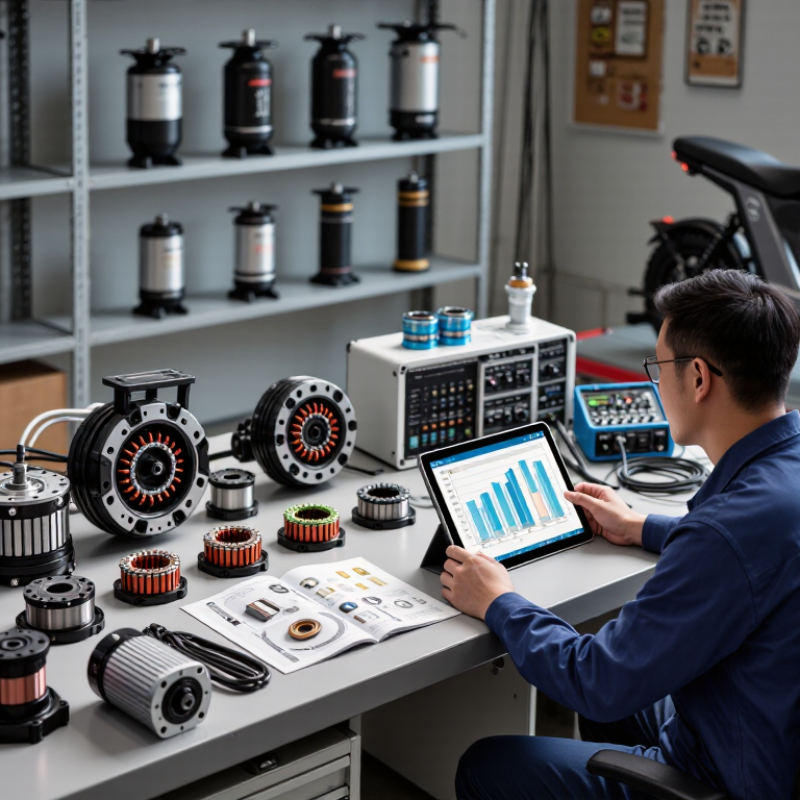
How Scooter Motors Work and Which Types Serve Different Scooters
A scooter motor converts battery power into wheel rotation. The controller rapidly switches current through stator windings, creating a rotating magnetic field. The rotor follows that field and produces torque. Simple in principle. Sensors or sensorless control help the system adjust current as speed changes. Battery voltage, winding design, and cooling all affect performance. Heat is the quiet limit, especially during repeated hill climbs.
Motor choice depends on the scooter’s job. A hub motor sits inside a wheel, reducing transmission parts and routine adjustment. But its added wheel weight can make rough pavement feel harsher. A mid-drive motor sends power through a belt or gears, often helping maintain climbing torque; it also adds drivetrain complexity. Both designs commonly use permanent-magnet synchronous or brushless DC architectures. The labels can overlap in commercial descriptions, so buyers should check controller compatibility and rated output, not rely on terminology alone.
The International Energy Agency’s Global EV Outlook 2024 reports that
electric two- and three-wheeler sales exceeded 14 million in 2023, roughly one-fifth of category sales worldwide.
That scale makes motor selection more than a specification-sheet issue. For short, flat commutes, a modest hub system may be adequate. For steep routes, frequent loads, or long operating hours, sustained torque and thermal management deserve closer inspection. A peak-power figure alone can mislead. Test conditions are not always comparable.
What Buyers Should Evaluate When Choosing a Scooter Motor Manufacturer
China Top 10 Scooter Motor Manufacturers for Buyers
What Buyers Should Evaluate When Choosing a Scooter Motor Manufacturer
IEA’s Global EV Outlook 2024 estimates that around 10 million electric two- and three-wheelers were sold in 2023. That scale makes supplier consistency important. Compare continuous power, peak power, torque curves, and efficiency maps—not just headline wattage. Numbers matter. Ask manufacturers to show test conditions and measured results.
A useful evaluation starts with your actual scooter: rider load, wheel size, hills, stop-start traffic, and expected daily distance. Request sample motors and test them under sustained load. Check winding temperature, noise, vibration, connector fit, and performance after repeated climbs. Review production checks, material traceability, warranty terms, and spare-part availability. A single lab score can mislead; low-speed tuning is easy to overlook. Ask how the motor behaves when hot, not only when new.
Tips: Send every shortlisted supplier the same duty cycle and comparison sheet. Request efficiency and temperature data from the same operating points. Keep a sample for independent testing, and record any differences between the sample and production units. A polished brochure is not proof.
Profiles of 10 Scooter Motor Manufacturers Based in China
China’s scooter-motor sector includes factories with different strengths; a useful profile compares engineering focus, production process, and support—not claims alone.
One manufacturer may specialize in compact hub motors, supplying sealed units for small urban scooters and straightforward installation. A second focuses on mid-drive systems, where torque delivery and controller matching matter more than headline wattage. A third builds geared motors for hill starts, while another favors direct-drive designs with fewer moving parts. A fourth may offer custom winding options; buyers should request test curves under realistic loads. A fifth concentrates on laminated cores and winding consistency. Small process differences matter.
A sixth serves OEM projects with sample runs before larger orders, though lead times can shift. A seventh focuses on weather-resistant housings, with cable exits and seals worth inspecting closely. An eighth may supply motors and controllers as matched sets, reducing compatibility work during assembly. A ninth emphasizes quiet operation and vibration control; request sound measurements, not adjectives. A tenth offers broad voltage ranges, but one catalog cannot prove equal performance across every configuration. Compare efficiency curves, thermal limits, bearing specifications, and quality checks. Ask for traceable test records and a sample under your own load conditions. I would not treat a polished brochure as evidence. Supplier capabilities change, and published details may be incomplete; verify current capacity directly.
How the Top Manufacturers Compare in Products, Capabilities, and Markets
China’s leading scooter-motor suppliers differ less by headline wattage than by engineering fit. Some focus on compact hub motors for urban commuting; others offer mid-drive systems, controllers, displays, and battery integration. Buyers should compare continuous output, peak power, torque curves, thermal behavior, ingress protection, and test records. A 500-watt label alone proves little.
Market readiness matters too. The International Energy Agency’s Global EV Outlook 2024 reports nearly 10 million electric two- and three-wheelers sold worldwide in 2023. That scale favors suppliers able to support volume, but export markets still demand different voltage ranges, connector standards, documentation, and after-sales response. Ask for sample test data, production capacity, lead times, and warranty terms. Then verify claims with a pilot batch. I would not treat factory size as a proxy for reliability; that assumption is easy to make, and sometimes wrong.
Tips: Send the same duty-cycle brief to every candidate: rider and cargo weight, gradients, daily distance, wheel size, and climate. Request matched test results, not brochure figures. Check spare-part availability before negotiating price.
How to Verify Suppliers and Prepare a Scooter Motor Purchase Specification
For buyers comparing China’s top scooter motor manufacturers, supplier verification should begin with evidence, not a polished catalog. The IEA’s Global EV Outlook 2024 estimates that nearly 10 million electric two- and three-wheelers were sold worldwide in 2023. That scale makes consistent quality checks important. Request a factory audit, recent production-test records, and calibration dates for the instruments used. Ask whether the quoted motor was tested with your intended controller, battery voltage, and wheel load. A certificate alone cannot confirm that a production batch matches your sample.
Prepare a purchase specification with rated voltage and power, continuous and peak torque, speed range, duty cycle, cooling method, operating temperature, shaft dimensions, and connector details. Define pass/fail limits for noise, vibration, efficiency, and temperature rise. Include the test setup and sampling rate; otherwise, two suppliers may report numbers that look comparable but are not. Ask for material traceability and serial-level test data where practical. Then inspect a pre-production sample under realistic load. Small details matter: a few millimeters of shaft difference can delay assembly.
Tips: Send the same specification to every supplier. Keep one approved sample as a reference. Recheck after design changes. This process takes time, and it may still miss a production issue, so plan incoming checks rather than trusting paperwork alone.