
Top 10 Industrial Managed PoE Switches to Buy in 2026?
Choosing an Industrial Managed Poe Switch in 2026 is about more than counting ports or comparing prices. A switch may sit inside a dusty cabinet, power cameras across a long cable run, and keep communicating through vibration or temperature changes. Those details matter more than a polished product photo.
This guide compares ten industrial managed PoE switches for different network needs, from compact edge installations to larger systems with fiber uplinks and advanced traffic controls. It considers PoE standards and power budgets, port speeds, operating temperature ranges, redundancy options, management tools, and warranty support. These are practical checks, not a promise that one model fits every site.
Look closely at the power budget. A switch with many PoE ports may not be able to power every connected device at full demand. Check each device’s requirements, cable length, and expected startup load. Then review the datasheet and confirm that the operating environment matches your installation. Specifications can change between hardware revisions. That part is easy to miss.
The picks are intended as a useful starting point, not a substitute for system design or vendor confirmation. Some products look nearly identical on paper. In real deployments, firmware quality and support can make the difference. That is worth questioning. Before buying, verify current availability, regional specifications, and compatibility with the equipment already in your network.
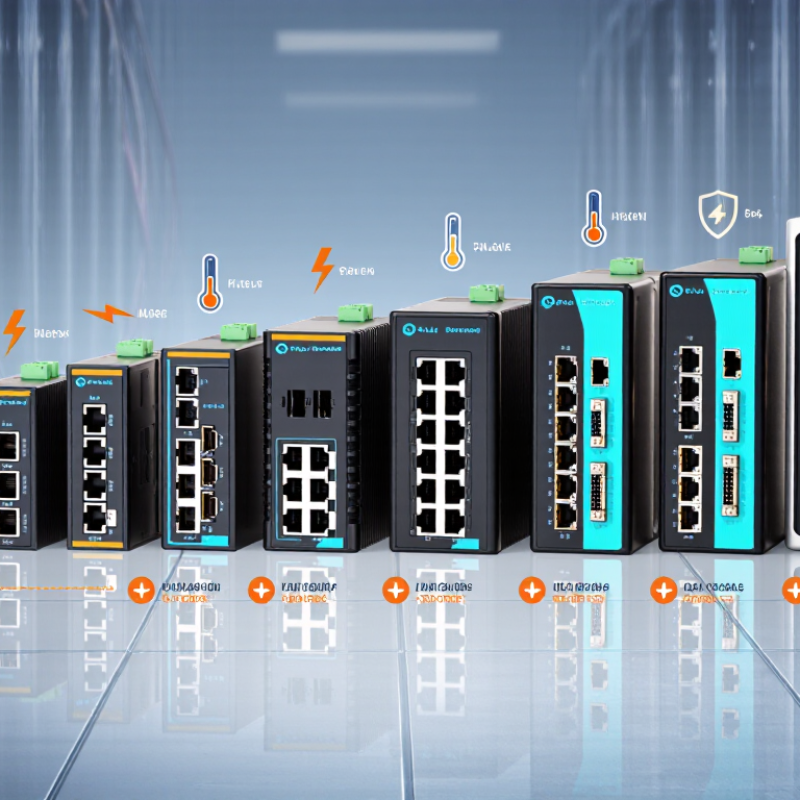
What Industrial Managed PoE Switches Do in Networked Systems
Top 10 Industrial Managed PoE Switches to Buy in 2026?
Industrial managed PoE switches carry network data and electrical power over one Ethernet cable. They can connect cameras, wireless access points, sensors, and control devices without a separate power outlet at every location. Management features let technicians separate traffic into VLANs, prioritize time-sensitive data, and check port status remotely. A dashboard can reveal a disconnected camera or a port drawing unexpected power. Small details matter. In industrial settings, switch models vary in temperature ratings, power budgets, and mounting options, so check the specifications against the actual site.
Tips: Add up the power needs of every connected device, then leave spare capacity for startup peaks or future additions. Check each port’s PoE limit, not only the switch’s total budget. Confirm cable routes, enclosure conditions, and network redundancy before installation. A useful log of port names and connected equipment makes later troubleshooting faster.
Managed features help, but they cannot fix poor cabling or an undersized power supply. Still, deployment is rarely tidy: a sensor may be added late, or a cabinet may run hotter than expected. Monitoring alerts and configuration backups can reduce surprises, though they need regular review. Not always glamorous, but dependable network planning often comes down to those checks.
Features That Distinguish Industrial-Grade Managed PoE Switches
Top 10 Industrial Managed PoE Switches to Buy in 2026?
Features That Distinguish Industrial-Grade Managed PoE Switches
An industrial managed PoE switch must do more than deliver power. Check its total PoE budget, not just the maximum output per port. A camera may need less power at startup, while a wireless access point can draw more under load. Leave headroom for both. A crowded cabinet gets hot quickly.
Management features matter when a network spans production lines, outdoor cabinets, or remote pump stations. VLANs separate traffic, while Quality of Service can prioritize control data over routine monitoring. Look for useful diagnostics, too: port-level power readings and event logs can help locate a failing cable without sending someone across a site. Redundant ring support may reduce downtime, but only when the network is designed and configured to use it.
Check the physical details. A wide operating-temperature range, vibration-resistant mounting, and clear surge-protection specifications are more meaningful than a rugged-looking case. DIN-rail installation helps in compact control cabinets. Still, ratings vary, and “industrial” alone proves little. Review the datasheet and confirm performance against the actual site conditions. Firmware support and secure management access deserve attention as well. These details are easy to overlook. A switch can be technically capable and still be the wrong fit if its power budget, environment rating, or management tools do not match the installation.
How to Compare Ports, PoE Budgets, Ruggedness, and Management
For a 2026 industrial managed PoE switch, compare what each port must support, not just the port count. HMS Networks’ 2024 Industrial Network Market Share report estimates that Industrial Ethernet represented 71% of newly installed factory-automation nodes, up from 68% in 2023. That growth makes dependable switching more important, but it does not mean every installation needs advanced features. Check the uplink speed, VLAN and QoS options, network redundancy, and whether configuration backups are straightforward.
Calculate the PoE budget across all connected devices, with headroom for startup peaks. IEEE 802.3bt allows up to 90 watts from the power-sourcing equipment, while a powered device can receive up to 71.3 watts. Those are maximums, not a promise that every port can deliver full power simultaneously. For ruggedness, check the specified temperature range, vibration and surge testing, ingress protection, and redundant power inputs. Small details matter. A fanless unit may still struggle inside a hot, sealed cabinet.
Tips: List each camera, access point, and sensor with its peak wattage before comparing models. Leave reserve capacity, and verify the total PoE budget at your expected cabinet temperature. Ask for the exact test conditions behind ruggedness claims; a broad “industrial-grade” label is not enough. I would not choose on port count alone. It is an easy shortcut, and sometimes the wrong one.
Top 10 Industrial Managed PoE Switches to Consider in 2026
A practical shortlist should match the installation, not chase the biggest specification. Consider a compact four-port switch for a small camera cabinet, an eight-port model for a workshop, and a 16-port unit for a growing production line. Gigabit ports suit most access devices. A 2.5GbE option can help with higher-throughput wireless access points. Fiber uplinks provide distance between buildings or network cabinets. High-power PoE models support devices with heavier draw, while wide-temperature designs suit unheated enclosures. Redundant DC inputs can reduce disruption if one supply fails. Layer 3 features may help segment larger networks. Finally, compare managed models by VLAN, traffic-priority, and monitoring tools. These are ten useful profiles, not a universal ranking. A perfect shortlist is hard; site conditions often change the answer.
Tips: Check the total PoE budget and each port’s supported power level against device requirements. Confirm operating-temperature ratings, mounting clearance, and surge protection needs. Ask for test data or a clear datasheet, and verify that the chosen PoE standard matches connected equipment. Leave spare capacity for future devices. That sounds obvious, but it is easy to overlook during a rushed upgrade.
| # | Configuration Profile | PoE Ports | PoE Standard & Indicative Total Budget | Uplink Options | Indicative Switching Capacity | Typical Operating Temperature Options | Best-Fit Applications |
|---|---|---|---|---|---|---|---|
| 1 | Compact Fast Ethernet DIN-Rail switch | 4 × 10/100 Mbps | IEEE 802.3af/at; approximately 60–120 W aggregate | 2 × Gigabit Ethernet, often with an SFP option | Approximately 2.8 Gbps, depending on port configuration | Common industrial options include −40°C to +75°C | Small control cabinets, a few IP cameras, or access points with modest bandwidth needs |
| 2 | Eight-port Fast Ethernet PoE switch | 8 × 10/100 Mbps | IEEE 802.3af/at; approximately 120–240 W aggregate | 2 × Gigabit Ethernet or 2 × SFP | Approximately 3.6 Gbps for an 8-port Fast Ethernet plus 2-port Gigabit layout | Common industrial options include −40°C to +75°C | Legacy camera systems, building automation, and bandwidth-light edge devices |
| 3 | Eight-port Gigabit PoE switch | 8 × 10/100/1000 Mbps | IEEE 802.3af/at; approximately 120–240 W aggregate | 2 × Gigabit Ethernet or SFP uplinks | Approximately 20 Gbps with 10 Gigabit Ethernet ports total | Industrial models are commonly offered in −40°C to +75°C variants | Gigabit cameras, wireless access points, and compact production networks |
| 4 | Eight-port Gigabit switch with fiber uplinks | 8 × 10/100/1000 Mbps | IEEE 802.3af/at; approximately 120–240 W aggregate | 2 × Gigabit SFP slots; transceiver choice depends on link type and distance | Approximately 20 Gbps with 10 Gigabit Ethernet ports total | Common industrial options include −40°C to +75°C | Remote cabinets, fiber-connected camera clusters, and electrically noisy sites |
| 5 | Sixteen-port Gigabit PoE switch | 16 × 10/100/1000 Mbps | IEEE 802.3af/at; approximately 240–480 W aggregate, subject to power-supply capacity | 2–4 × Gigabit SFP or Ethernet uplinks | Approximately 36–40 Gbps, depending on uplink count | Industrial models are commonly offered in −40°C to +75°C variants | Medium-sized surveillance networks and distributed machine-vision devices |
| 6 | Twenty-four-port Gigabit PoE switch | 24 × 10/100/1000 Mbps | IEEE 802.3af/at; approximately 360–720 W aggregate, depending on the power design | 2–4 × Gigabit SFP or Ethernet uplinks | Approximately 52–56 Gbps for 24 access ports plus 2–4 Gigabit uplinks | Industrial temperature versions are available; confirm the rating for the exact model | Large access-layer installations in factories, transport facilities, and campuses |
| 7 | Gigabit PoE switch with 10 Gigabit uplinks | 8 × 10/100/1000 Mbps | IEEE 802.3af/at; approximately 120–240 W aggregate | 2 × 10 Gigabit SFP+ slots | Approximately 48 Gbps with two 10 Gigabit uplinks | Industrial models may offer extended-temperature versions; check the specification | High-resolution video networks needing faster backbone connections |
| 8 | Sixteen-port Gigabit PoE switch with 10 Gigabit uplinks | 16 × 10/100/1000 Mbps | IEEE 802.3af/at; approximately 240–480 W aggregate, subject to the power supply | 4 × 10 Gigabit SFP+ slots | Approximately 112 Gbps with 16 Gigabit access ports and four 10 Gigabit uplinks | Temperature range varies by hardware and power-supply option | Aggregating multiple edge switches or supporting dense video and wireless traffic |
| 9 | Multi-Gigabit PoE switch for newer access points | Typically 8 × 2.5 Gigabit Ethernet | IEEE 802.3at and, on selected ports, IEEE 802.3bt; aggregate budget varies by model | 2 × 10 Gigabit SFP+ or equivalent high-speed uplinks | Approximately 60 Gbps for 8 × 2.5 Gigabit ports plus 2 × 10 Gigabit uplinks | Industrial temperature options vary; verify the complete operating range | Wi-Fi access points and devices that can exceed the throughput of a Gigabit port |
| 10 | High-power PoE switch for demanding edge devices | Typically 4–8 PoE-capable ports, with power levels depending on port support | IEEE 802.3bt-capable ports can supply up to 90 W per port at the power sourcing equipment; total budget depends on the switch and supply | Gigabit or 10 Gigabit Ethernet/SFP+ options, depending on configuration | Varies with access-port speeds and uplink count | Extended-temperature options are model-specific | High-power wireless units, PTZ cameras, and other devices requiring more than standard PoE+ power |
Figures are indicative configuration examples, not specifications for named products. Actual PoE budgets, port combinations, switching capacity, temperature ratings, redundancy features, and supported management protocols vary by model. IEEE 802.3af, 802.3at, and 802.3bt define maximum power levels per port; the usable aggregate budget is limited by the switch’s power supply and design.
How to Match a Switch to Your Deployment Requirements
HMS Networks’ 2024 Industrial Network Market Shares report estimated that Industrial Ethernet accounted for 71% of newly installed industrial network nodes. That shift makes port count, uplink capacity, and segmentation essential selection criteria. List every device first: cameras, access points, sensors, and control panels. Record each device’s PoE standard and peak draw, then allow headroom for startup demand and future additions. A 24-port label does not guarantee enough power for 24 devices.
Compare the switch’s total PoE budget with the combined device load. IEEE 802.3bt Type 4 supports up to 90 watts from the power-sourcing equipment, but cable losses reduce delivered power. Check operating-temperature limits, vibration tolerance, DIN-rail fit, and redundant power inputs against the actual cabinet conditions. Heat changes everything. For network control, assess VLANs, traffic prioritization, and remote diagnostics; a managed switch is only useful if its features match staff skills and maintenance routines. A tidy spreadsheet can still miss a hot enclosure or an unexpected camera upgrade, so leave practical margin rather than sizing to the last watt.


