China Top 10 MIG Welding Machine Manufacturers?
Choosing among China’s top 10 Mig Welding machine manufacturers takes more than comparing catalog prices. A compact inverter welder may suit a repair bench, while a production line needs stable wire feeding, repeatable settings, and dependable service. Mig Welding performance also depends on material thickness, duty cycle, shielding gas, and operator skill. Small details matter. A torch that feels balanced after an hour can be more valuable than an impressive feature list.
Welding metallurgy expert Dr. John C. Lippold’s work highlights a useful principle: weldability depends on the material, process, and intended service conditions. This is a paraphrase, not a direct quotation. It offers a sensible lens for comparing manufacturers. Look for clear technical specifications, documented quality systems, accessible spare parts, and responsive support. Ask how machines perform during continuous use, not just during a short demonstration. Check whether the stated duty cycle matches your actual workload. A polished brochure cannot answer every question.
This guide examines ten Chinese manufacturers through practical buying criteria, including machine range, control features, export experience, and after-sales support. It does not treat one brand as the best choice for every workshop. That would be too easy. Public information can also be uneven, and factory claims deserve careful verification. Use the list as a starting point, then request test results, warranty terms, and a live welding trial. The right MIG machine should make a clean, consistent bead—and remain supportable long after delivery.
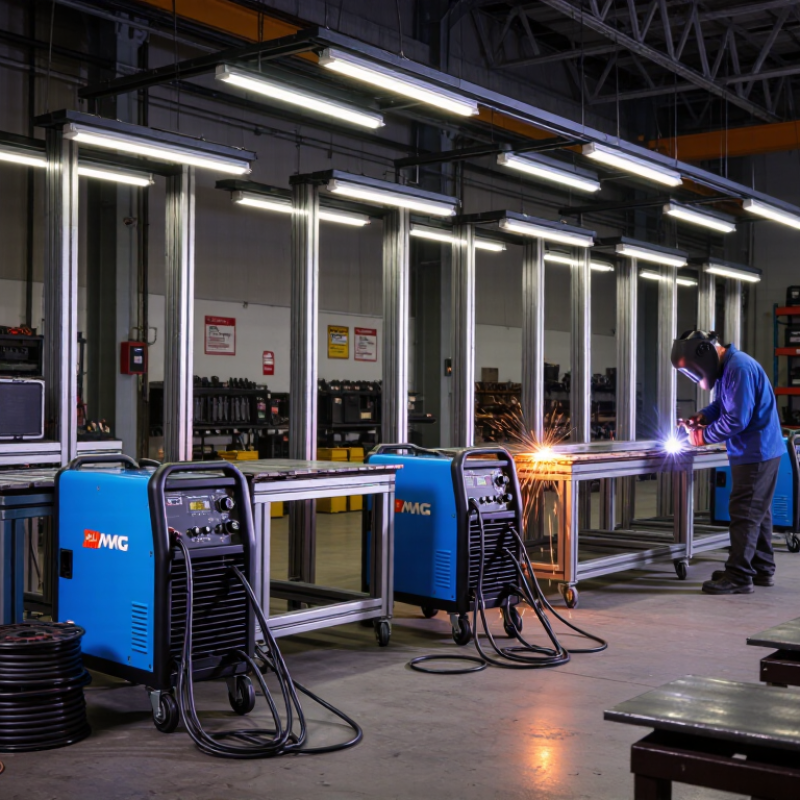
Understanding MIG Welding Machines and Their Role in China
MIG welding, also called gas metal arc welding, feeds a continuous wire electrode through a torch. An electric arc melts the wire and base metal, while shielding gas helps protect the weld pool from air. The process is valued for steady output and relatively fast operation. It suits many workshops, though setup still matters.
China’s manufacturing sector uses MIG equipment across applications such as vehicle parts, machinery, and metal furniture. Local production ranges from basic inverter machines to models with pulse control and digital settings. These features can help manage heat on thinner sheets, but they do not guarantee a clean weld. Wire quality, gas flow, joint preparation, and operator technique remain important. In practice, even a small change in torch angle can affect the bead.
Tips: Check the duty cycle. Match wire diameter to the feeder and job. Confirm the machine’s output range fits the material thickness. For a purchase, ask about service access, spare parts, and realistic test results—not only advertised power. A short trial on the intended metal can reveal unstable feeding or excessive spatter. It is easy to overlook this step.
Criteria for Identifying Leading Chinese MIG Welding Manufacturers
Identifying leading Chinese MIG welding manufacturers requires more than comparing catalogues and quoted prices. Check arc stability on thin sheet and thicker plate, wire-feed consistency, and duty-cycle performance. Request test results with voltage, ambient temperature, and operating conditions stated. The International Federation of Robotics’ World Robotics 2024 report recorded 276,288 industrial robot installations in China in 2023, representing 51% of global installations. This points to a strong automation ecosystem, but it does not prove any individual machine’s quality. Important distinction.
Assess product conformity against IEC 60974-1, and ask for independent test reports where available. During factory audits, inspect calibration records, component traceability, weld samples, and spare-parts procedures. The World Steel Association reported that China produced 1,005.1 million tonnes of crude steel in 2023, about 54% of global output. That scale signals substantial industrial demand, not supplier reliability. There are blind spots. A checklist may miss inconsistent performance between production batches, so test more than one unit under comparable conditions. Also confirm whether stated duty cycles match the machine’s rating plate and documented test conditions.
Profiles of Ten Notable MIG Welding Machine Manufacturers in China
A name-free profile of ten Chinese MIG welding machine manufacturers is most useful when it compares capabilities, not slogans. One profile may emphasize compact inverter units for repair shops. Another may focus on higher-duty-cycle machines for fabrication lines. A third may offer synergic controls that simplify wire-feed and voltage adjustment. The fourth may specialize in pulse welding for thinner sheet. The fifth may prioritize rugged cabinets and straightforward service access. Small details matter.
The remaining profiles can highlight multi-process platforms, entry-level equipment, export-oriented configurations, digital monitoring, or custom production systems. These are comparison dimensions, not verified claims about specific companies. Buyers should check rated output, duty cycle, wire-feed stability, and spare-part availability. Ask for test records. A polished brochure is not enough. This grouping is imperfect: manufacturers often overlap, and model specifications change.
China’s manufacturing scale provides useful context, but not a direct measure of MIG machine sales. The International Federation of Robotics’ World Robotics 2024 report records
276,288 industrial robot installations in China in 2023, about 51% of global installations.
That figure signals a large automation ecosystem; it does not establish welding-machine market share or product quality. For a credible comparison, pair published specifications with sample welds, service response times, and operating costs. A clean bead tells only part of the story.
Comparing Product Ranges, Technologies, and Certifications
When comparing China’s top MIG welding machine manufacturers, product range matters more than a headline power rating. Check whether a supplier offers compact inverter units, industrial MIG/MAG systems, pulse models, and multiprocess machines. Ask for duty-cycle figures at the stated amperage, not just maximum output. A workshop running 250 amps through a long shift needs different cooling and wire-feed performance from a repair shop making short welds. Small details matter.
Technology claims need practical checks. Synergic control can simplify setup, while pulse modes may help manage heat on thin sheet. Yet feature lists do not prove stable arc performance. Request test welds using your wire diameter, gas mix, and material thickness. Grand View Research estimated the global welding equipment market at about USD 15.47 billion in 2023, with projected growth of 5.9% annually from 2024 to 2030. That broader market trend makes clear specifications and after-sales support increasingly important.
Compare certifications by scope and model. ISO 9001 concerns a manufacturer’s quality-management system; it does not certify every machine’s welding performance. For equipment safety, review applicable IEC 60974 requirements and ask for current test documentation. Export buyers should also verify destination-market conformity, traceable serial numbers, and spare-parts availability. Paperwork can look tidy. Test it. A missing certificate scope, unclear warranty terms, or inconsistent rated-duty data deserves follow-up before a purchase decision.
Factors to Consider When Selecting a Chinese MIG Welder Supplier
When comparing Chinese MIG welder suppliers, look beyond a polished catalog. Ask for the rated output, input-voltage range, and duty cycle at a stated ambient temperature. A 60% duty-cycle claim means little without its test conditions. Request a test report against IEC 60974-1, the safety standard for arc-welding power sources, and confirm the model number matches the machine being quoted. Numbers can mislead.
Quality systems matter, but certificates are not proof of every unit’s performance. The ISO Survey of Management System Standard Certifications 2022 recorded 1,265,216 valid ISO 9001 certificates worldwide. Treat certification as a starting point: check its scope, validity, and issuing body. Then request factory inspection records, spare-parts lead times, warranty terms, and a video or live demonstration on the wire and material you use. Watch the arc start, wire feed, and heat buildup. Paper is not performance.
Response quality is another practical test. Send a precise technical question and note whether the supplier answers with measurements or vague promises. Ask who handles faults after shipment and which consumables are readily available. A minor weakness can be revealing: documentation may be clear while service response remains slow. Verify both before placing a larger order.
China Top 10 MIG Welding Machine Manufacturers? — Factors to Consider When Selecting a Chinese MIG Welder Supplier
Common MIG/MAG Shielding-Gas Mixtures
Check that a supplier’s machines support the shielding gases required for your materials and welding process. These are commonly used gas mixtures; the best choice depends on the application.