
What Are the Top Anodized Aluminum Profiles in 2026?
Anodized Aluminum Profiles are chosen for more than their clean metallic finish. In 2026, buyers will compare corrosion resistance, coating consistency, dimensional accuracy, and total service life. The International Aluminium Institute reported approximately 70.6 million tonnes of global primary aluminum production in 2023. That figure describes primary metal, not finished profiles. Still, it shows the scale of the material supply behind construction, transport, and industrial products. Not the whole story. A profile’s performance also depends on its alloy, temper, extrusion quality, and anodizing process.
This guide examines leading profile types for practical uses: 6063 architectural sections for window frames and curtain walls, slim solar-panel rails, heat-sink extrusions, and durable trims. Details matter. A dark storefront mullion, for example, may need consistent color across long runs, while an outdoor rail needs a coating suited to weather exposure. ISO 7599:2018 provides general specifications for anodic oxidation coatings on aluminum, offering a useful reference when evaluating finish requirements. It does not, by itself, establish which profile is best for every project. That depends on the application, exposure, fabrication method, and supplier quality controls. Some rankings make this sound simpler than it is. This article compares profiles by those real-world factors, while noting where published data cannot support a universal “top” choice.
What Defines an Anodized Aluminum Profile?
An anodized aluminum profile is an extruded section whose surface has been converted into aluminum oxide through an electrochemical process. Not a paint layer. The oxide grows from the metal itself, and its pores are commonly sealed afterward. A profile may appear clear, bronze, or black, but color alone says little about durability. Alloy choice, pretreatment, coating thickness, and sealing also matter.
ISO 7599:2018 sets requirements for decorative and protective anodic oxidation coatings on aluminum. In practical specifications, buyers should check coating thickness, color consistency, dimensional tolerances, and the intended environment. A freshly cut end can expose untreated metal if cutting happens after anodizing. That detail is easy to miss. It can affect how an assembly looks and performs.
The International Aluminium Institute reports that recycling aluminum uses about 95% less energy than producing primary aluminum. That figure concerns metal recycling, not anodizing. Recycled content should therefore be verified separately; an anodized finish does not prove where the metal came from. There is a catch: no single coating thickness or finish suits every exposure, and choosing one without considering use can lead to disappointment.
Which Anodized Aluminum Profile Types Stand Out in 2026?
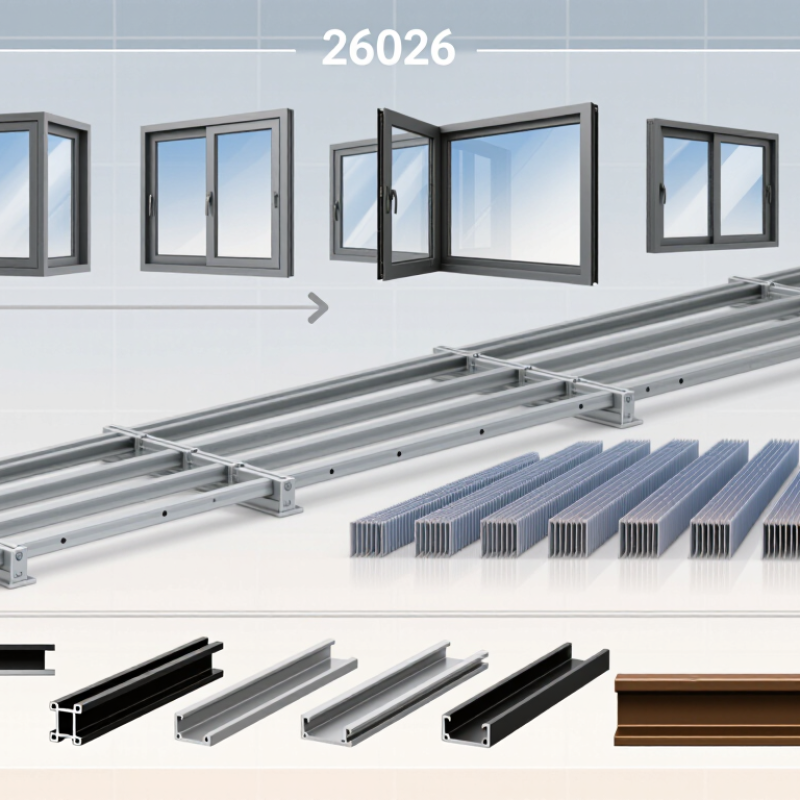
In 2026, four anodized profile types stand out: architectural frames, T-slot sections, heat sinks, and solar mounting rails. Architectural profiles suit door and curtain-wall systems, where a consistent bronze, black, or clear finish matters. T-slot profiles offer flexible assembly for workstations and machine guards. Heat-sink profiles use fins to increase surface area, while solar rails need straight, repeatable channels for secure panel mounting. Fit matters.
Demand supports this range, but does not prove every profile will sell equally well. The International Aluminium Institute’s 2023 report projected global aluminium demand could rise nearly 40% by 2030, driven partly by construction and transport. Grand View Research estimated the global aluminium extrusion market at about US$90.4 billion in 2023, with growth projected through 2030. These figures cover aluminium broadly, not anodized profiles alone. For buyers, the practical choice depends on load, exposure, and assembly details. A coastal rail may need a more carefully specified finish than an indoor divider. Anodizing is not maintenance-free; trapped moisture and damaged edges still deserve attention.
Sulfuric Type II is a versatile choice for general-purpose profiles, while Type III hardcoat provides a thicker coating for applications needing greater wear resistance. Type I coatings are typically thinner. Ranges shown are indicative; actual coating thickness depends on the specification and application.
How Do Leading Profile Types Compare in Strength and Finish?
What Are the Top Anodized Aluminum Profiles in 2026?
For strength, 6061-T6 profiles suit brackets, machine frames, and other load-bearing parts. ASTM B221 specifies a minimum tensile strength of about 260 MPa for many 6061-T6 extrusions. By comparison, 6063-T5 profiles are commonly specified at about 145 MPa; 6063-T6 reaches about 205 MPa. Exact values depend on profile dimensions and temper. 6063 is often chosen for architectural shapes because it extrudes cleanly and can produce an even-looking anodized surface. Not always obvious. Alloy, die condition, and pretreatment can all shift the final color, so a sample finish is worth checking before a large order.
Finish thickness matters too, but thicker is not automatically better. AAMA 611-20 sets minimum coating thicknesses of about 18 micrometres for Class I anodizing and 10 micrometres for Class II. Class I is commonly selected for demanding exterior exposure; Class II can suit less severe conditions and appearance-focused interiors. Ask the supplier to state the alloy, temper, anodizing class, and inspection method. That detail matters. A strong 6061 frame may be the wrong choice if a highly consistent decorative finish is the main goal, while a slim 6063 trim profile may not provide enough structural margin. Check the actual load and finish sample.
Where Are Top Anodized Profiles Used Across Industries?
Anodized aluminum profiles are widely used in building envelopes, window frames, curtain walls, and interior partitions. Their hard oxide surface handles weather exposure and frequent contact, while the extrusion can accommodate channels for seals, drainage, and fasteners. The UNEP Global Status Report for Buildings and Construction 2024/25 says buildings and construction accounted for 32% of global energy use and 34% of energy- and process-related CO₂ emissions in 2023. That scale makes durable, well-fitted components relevant, though a profile alone cannot make a building efficient. Small details matter.
Solar installations are another visible use. Rails and module frames face sunlight, rain, dust, and repeated temperature changes. The IEA’s Renewables 2024 report records nearly 510 GW of renewable capacity additions in 2023, with solar PV responsible for about three-quarters. In transport, anodized profiles can serve as trim, structural supports, and equipment housings. The IEA Global EV Outlook 2024 reports nearly 14 million electric cars were sold in 2023, around 18% of all car sales. Factory automation and electronics also use profiles for machine frames, heat-sink assemblies, and protective enclosures. A real trade-off: anodizing improves surface performance, but cut edges, damaged finishes, and poor drainage still need attention. Not every application needs the same coating thickness or finish.
What Factors Guide the Selection of an Anodized Profile?
Selecting an anodized aluminum profile in 2026 starts with its real job: carrying a load, framing glass, or guiding a sliding panel. Match alloy and wall thickness to the span, fasteners, and expected impact. The Aluminum Association’s Aluminum Design Manual provides engineering properties for structural aluminum alloys; use those values rather than judging strength by appearance. Finish matters, too. Specify anodizing class and coating thickness for the exposure, then check color consistency across batches. A bright showroom sample can mislead.
For window and façade profiles, thermal performance may outweigh a slightly lower purchase price. The U.S. Department of Energy reports that heat gain and loss through windows account for 25–30% of residential heating and cooling energy use. That is a system-level figure, not a guarantee about one frame, but it makes thermal breaks worth evaluating. Ask for whole-window performance data, not just profile conductivity. Also inspect drainage paths, gasket seats, corner joints, and cut-edge protection. Small gaps can invite water and staining. A profile that looks precise on paper may still be awkward to install. Test a short assembly under site conditions before ordering at scale.
| Profile Type | Common Alloy and Temper | Typical Anodized Finish | Key Selection Factors | Common Applications |
|---|---|---|---|---|
| Architectural window and curtain-wall profile | 6063-T5 or 6063-T6 | Clear, bronze, or black; specify coating thickness and sealing requirements for the intended exposure. | Visible surface quality, dimensional tolerances, structural loads, drainage details, color consistency, and indoor or outdoor exposure. | Window frames, door frames, storefronts, and curtain-wall components. |
| Modular T-slot framing profile | 6063-T5 is common; 6061-T6 may be selected where higher strength is required. | Often clear or black anodized; confirm that the finish does not interfere with slot fit or accessory contact points. | Slot dimensions, load and deflection requirements, connection method, assembly frequency, and compatibility with fasteners and accessories. | Machine guards, workstations, equipment frames, and modular enclosures. |
| Heat-sink profile | 6063-T5 or 6063-T6 | Clear or black anodized, depending on appearance and thermal-radiation requirements. | Thermal resistance, fin spacing, airflow, available extrusion geometry, operating temperature, and electrical-contact requirements. | LED fixtures, power electronics, and other electronic cooling assemblies. |
| Solar mounting profile | 6005A-T6 or 6063-T6, depending on design and load requirements. | Typically clear anodized; coating specification should reflect the installation environment. | Wind and snow loads, span, fastener compatibility, roof or ground-mount conditions, drainage, and exposure to moisture or salt. | Solar-panel rails, supports, and mounting components. |
| Structural or heavy-duty extrusion | 6061-T6 or 6005A-T6 | Clear or colored anodizing where a protective or decorative surface is required. | Design loads, section stiffness, wall thickness, machining needs, connection details, and whether the specified temper is suitable for fabrication. | Equipment supports, structural frames, transport components, and industrial assemblies. |
| Coastal or high-exposure architectural profile | Often 6063-T5 or 6063-T6; alloy and finish should be matched to the project specification. | Specify an appropriate anodic-film thickness, sealing, and maintenance plan for the exposure; anodizing does not make aluminum corrosion-proof. | Salt exposure, sheltered versus unsheltered location, water traps, dissimilar-metal contact, coating specification, and maintenance access. | Exterior frames, façade components, and other exposed building elements. |
Selection note: Alloy, temper, profile geometry, and anodic-film requirements should be confirmed against the project loads, environment, applicable standards, and supplier process capability. Anodizing thickness and color are specified by the applicable standard and project requirements; they are not interchangeable across specifications.


