
China Top SMC Enclosure Hydraulic Press Manufacturer?
Choosing a China Top Smc Enclosure Hydraulic Press Manufacturer requires more than comparing price lists. The right partner should understand SMC compression molding, enclosure geometry, cycle stability, and long-term production demands. This introduction examines how experienced Chinese manufacturers design and support the Smc Enclosure Hydraulic Press for industrial applications.
A dependable press should match the product’s mold size, material flow, closing force, heating method, and required cycle time. Practical details matter. A 315-ton machine may include heated platens, independent temperature zones, a PLC control system, hydraulic overload protection, and automatic ejection. These features can improve repeatability when molding electrical boxes, instrument cabinets, and weather-resistant covers. However, specifications need context. Published cycle times may exclude loading, curing, cooling, or manual trimming.
Evidence matters more than polished brochures. Buyers should request machine drawings, pressure curves, mold compatibility data, factory testing records, and videos of comparable production. A responsible manufacturer can explain steel selection, platen flatness, hydraulic maintenance, safety guarding, and spare-parts availability. Clear communication also reveals whether the supplier has real project experience or only resells standard equipment.
No supplier is perfect. Even a well-built machine may need control adjustments after installation. Uneven material placement can still create thickness variation. Therefore, this article compares manufacturing capability, engineering support, customization, quality control, commissioning, and after-sales service. It focuses on verifiable details, practical risks, and the questions buyers should ask before selecting a long-term hydraulic press partner in China.
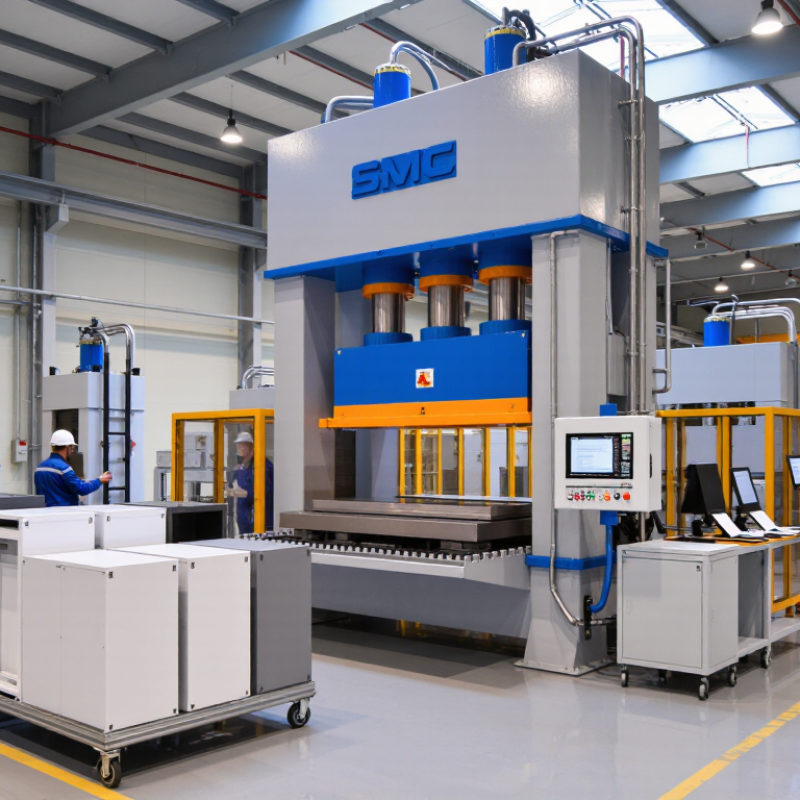
What Is an SMC Enclosure Hydraulic Press?
An SMC enclosure hydraulic press is industrial equipment used to mold sheet molding compound into protective electrical enclosures. SMC combines resin, fiberglass, and mineral fillers. Under controlled heat and pressure, this material forms rigid panels with accurate edges and consistent wall thickness.
The press typically includes a steel frame, hydraulic cylinders, heated platens, a mold set, and a programmable control system. Operators place prepared SMC charges into the mold, close the platens, and maintain pressure until curing is stable. Cycle settings depend on material formulation, enclosure size, mold design, and required surface quality. Too much pressure can damage inserts. Too little pressure may create voids or weak corners.
Practical experience matters.
A reliable manufacturer should verify platen parallelism, hydraulic stability, temperature uniformity, and emergency protection during factory testing. It should also provide mold trial records, load calculations, maintenance guidance, and operator training. These details are more useful than impressive capacity numbers alone.
China has many press manufacturers, but “top” should not mean the largest advertisement. It should reflect repeatable production, responsive engineering, and documented quality control. Even experienced teams can miss cooling variations or underestimate mold deflection. That is why sample testing with the customer’s actual SMC material remains important before final acceptance. The enclosure may look simple, yet its corners, mounting points, and sealing surfaces demand careful control.
Key Components and Working Principles of SMC Hydraulic Presses
A reliable SMC enclosure hydraulic press depends on coordinated components. The hydraulic power unit supplies pressurized oil through valves and pipelines. Cylinders convert that pressure into closing force. Steel platens distribute force across the mold surface. A heated mold controls resin flow and curing. Ejector cylinders then release the molded enclosure without damaging its edges. Sensors monitor pressure, platen position, oil temperature, and mold temperature. A PLC links these signals to the operating sequence.
The working cycle is precise but not complicated. Operators load measured SMC charge onto the lower mold. The upper platen closes slowly, allowing trapped air to escape. Pressure then rises until the material fills the cavity. Heat softens the resin, while sustained pressure supports curing and dimensional stability. Cooling begins before safe demolding. According to Grand View Research, the global SMC market is projected to grow at roughly 7% annually through 2030. MarketsandMarkets also identifies automotive and electrical applications as major composite demand areas. These trends increase expectations for repeatable pressure and temperature control.
In practical commissioning, uneven charge placement often causes more defects than insufficient press force. That detail is easy to overlook. A recent design review may recommend faster closing speeds, yet faster is not always better. It can trap air or shift the charge. One imperfect assumption remains common: maximum tonnage does not guarantee better enclosures. Mold stiffness, heating uniformity, cycle timing, and maintenance records matter equally. Calibration should be verified with traceable instruments, not only the machine display.
China Top SMC Enclosure Hydraulic Press Manufacturer? - Key Components and Working Principles of SMC Hydraulic Presses
| Category | Key Component or Parameter | Typical Technical Data | Function and Working Principle |
|---|---|---|---|
| Press Structure | Four-column or welded-frame body | Four-column, H-frame, or fabricated steel construction | Supports the mold, cylinder, and hydraulic loads while maintaining platen alignment during molding. |
| Main Hydraulic Cylinder | Double-acting ram cylinder | Nominal force commonly 1,000–10,000 kN; stroke commonly 300–1,000 mm | Converts hydraulic pressure into linear pressing force for mold closing, curing, and mold opening. |
| Hydraulic Power Unit | Motor, hydraulic pump, reservoir, valves, and filters | System pressure often 160–250 bar; filtration commonly 10–25 μm | The pump supplies pressurized oil, while control valves regulate flow direction, speed, and pressure. |
| Pressing Force | Molding force and pressure control | Typical SMC molding pressure: approximately 50–150 bar at the material or mold interface, depending on part design and process conditions | Controlled force consolidates the sheet molding compound and fills the mold cavity without excessive flash or fiber disturbance. |
| Upper and Lower Platens | Rigid heated mold mounting plates | Typical platen temperature range: 120–180°C; flatness and parallelism depend on machine design | Hold and heat the mold halves. Even temperature distribution supports consistent curing and dimensional stability. |
| Heating System | Electric cartridge heaters, oil heating, or water heating | Temperature control accuracy commonly within ±2–5°C, depending on sensor layout and controller | Raises the mold to the curing temperature required by the thermosetting resin system used in the SMC compound. |
| Mold | Matched metal mold for enclosure geometry | Usually manufactured from tool steel or other suitable mold-grade steel; cavity design includes ribs, bosses, and draft angles | Shapes the SMC charge into the enclosure body, cover, mounting features, and internal reinforcement structures. |
| Control System | PLC, touchscreen interface, pressure sensors, and temperature controllers | Programmable control of pressure, position, speed, temperature, dwell time, and alarm limits | Coordinates the molding cycle and records key process values for repeatability and quality monitoring. |
| Position Measurement | Linear transducer or proximity-based position sensors | Monitors ram position, mold opening, closing, and final compression distance | Helps control closing speed, protect the mold, and maintain consistent part thickness. |
| Guiding System | Guide columns, guide sleeves, and wear plates | Designed to maintain platen parallelism and reduce lateral mold movement | Guides the moving platen and distributes load evenly across the mold during compression. |
| Ejector System | Hydraulic or mechanical ejector pins | Ejection force and stroke are selected according to enclosure size, draft, and mold adhesion | Separates the cured enclosure from the mold after the press opens, minimizing deformation and surface damage. |
| SMC Material | Sheet molding compound | Thermosetting resin matrix reinforced mainly with chopped glass fibers and mineral fillers | The pre-impregnated compound flows under heat and pressure, then cures into a rigid composite part. |
| Typical Cycle Sequence | Charge placement, closing, compression, curing, opening, and ejection | Cycle time commonly ranges from approximately 1–10 minutes, depending on part thickness, resin system, and mold temperature | A controlled sequence ensures complete cavity filling, adequate curing, stable dimensions, and safe part removal. |
| Enclosure Applications | Electrical, control, telecommunications, and industrial enclosures | Common requirements include insulation, corrosion resistance, flame resistance, weather resistance, and dimensional stability | SMC compression molding produces strong, lightweight housings with integrated ribs, mounting points, and sealing features. |
| Safety and Maintenance | Light curtains, interlocks, emergency stop, oil inspection, and mold cleaning | Safety design should comply with applicable machinery and electrical safety requirements in the target market | Protects operators and equipment while maintaining hydraulic performance, mold cleanliness, and stable production quality. |
How China Manufactures High-Quality SMC Enclosure Presses
China’s SMC enclosure press manufacturing combines heavy-frame engineering with tightly controlled compression molding. Grand View Research reported that the global SMC market was valued at about USD 4.4 billion in 2023, with electrical applications supporting continued demand. This growth raises expectations for stable press performance.
Manufacturers typically weld thick steel frames, stress-relieve them, and machine platen surfaces on large CNC equipment. A practical SMC cycle may use mold temperatures near 140–160°C and pressures around 5–15 MPa, depending on part geometry. Hydraulic systems need responsive proportional valves, calibrated pressure sensors, and reliable oil filtration. Small errors matter. A slight platen tilt can create uneven wall thickness around an enclosure.
Quality control continues beyond assembly. Technicians check platen parallelism, pressure holding, hydraulic leakage, temperature uniformity, and emergency stopping functions. Production teams also record cylinder performance and test sample parts from each batch. MarketsandMarkets estimates that the global hydraulic press market will grow steadily through the decade, increasing pressure on suppliers to improve efficiency and serviceability.
In practice, not every cycle is perfect. That is worth admitting. Resin flow can change with storage time, fiber distribution, or mold wear. Experienced manufacturers respond with trial molding, measured adjustments, and documented corrective actions. Factory acceptance tests should use real enclosure molds, not only unloaded machine demonstrations. That detail often separates a dependable press from an impressive-looking machine.
Applications of SMC Enclosure Hydraulic Press Technology
SMC enclosure hydraulic presses produce strong, lightweight housings for demanding electrical applications. Common uses include distribution boxes, meter cabinets, control panels, telecom equipment, and charging infrastructure. The press applies controlled force and heat, forming ribs, mounting bosses, and sealing edges in one cycle. SMC also resists corrosion, moisture, and many industrial chemicals. Its electrical insulation supports safer enclosure designs. According to MarketsandMarkets’ 2024 Sheet Molding Compound Market report, the sector is projected to grow at about 6.5% annually through 2028. That growth reflects wider demand for durable composite components.
Electric vehicle infrastructure adds another practical application. The International Energy Agency reported nearly 14 million electric car sales worldwide in 2023. More charging points require compact outdoor enclosures with stable dimensional performance. A hydraulic press can maintain repeatable pressure across large molds, reducing warpage and inconsistent wall thickness. Yet, not every enclosure should use SMC. Complex tooling may raise initial costs, and poor fiber distribution can weaken corners. In production, technicians should inspect flash, voids, and insert alignment after molding. A smooth surface can still hide internal defects.
Tips: Match mold temperature, pressure, and curing time to the compound grade. Design generous corner radii and drainage paths. Test finished enclosures for impact, heat, insulation, and ingress performance under the target IEC requirements. Keep production records; small process changes can create large dimensional differences.
How to Evaluate a Leading Chinese SMC Press Manufacturer
China Top SMC Enclosure Hydraulic Press Manufacturer?
How to Evaluate a Leading Chinese SMC Press Manufacturer
Evaluating a Chinese SMC press manufacturer requires more than checking price or factory size. Review its experience with enclosure production, especially deep ribs, sharp corners, and uneven wall thickness. Ask for press references using similar materials and mold dimensions. A polished showroom proves little.
Inspect the hydraulic system closely. Confirm rated force, pressure stability, platen parallelism, and temperature control. Request measurement records, not only verbal assurances. During a factory visit, watch a trial run. Check whether the press holds pressure steadily and opens without damaging the molded part. Small leaks matter. So does noise.
A reliable manufacturer should provide drawings, load calculations, electrical layouts, and maintenance schedules. Its engineers must explain cycle time, mold ventilation, and safe operating procedures in clear language. Check component traceability and the availability of replacement seals, valves, and sensors. Independent testing records can strengthen confidence, but they should match the delivered machine.
Ask for installation support and operator training. Speak with previous customers about response time after commissioning. One common mistake is trusting the lowest quotation. It may exclude tooling trials, packing, or technical support. Another mistake is accepting impressive specifications without testing them. No evaluation is perfect. A written acceptance plan helps expose gaps before payment and delivery.


