Why Choose a Cryo Chiller for Industrial Cooling?
Industrial cooling is rarely just a matter of making something cold. A Cryo Chiller can help control process temperatures where heat affects product quality, equipment performance, or production consistency. It may serve laboratory systems, manufacturing lines, or specialized process equipment, depending on its design. The right unit must match the actual cooling load, operating temperature, required flow, and heat-transfer fluid. A mismatch can mean unstable temperatures, wasted energy, or avoidable wear. Small details matter.
Choosing a chiller starts with real operating conditions, not a headline temperature alone. Consider how quickly the process gains heat, whether loads change during a shift, and how much space is available for installation. Check fluid compatibility and plan for routine inspection, cleaning, and service access. These practical checks help buyers compare systems on more than purchase price. Still, specifications do not tell the whole story. Site conditions and control requirements can change the outcome, and estimates may need revision after testing. This guide explains why a Cryo Chiller may suit industrial cooling, what performance factors to assess, and which questions to ask before selecting a system. The goal is a reliable decision, not the coldest number on a datasheet.
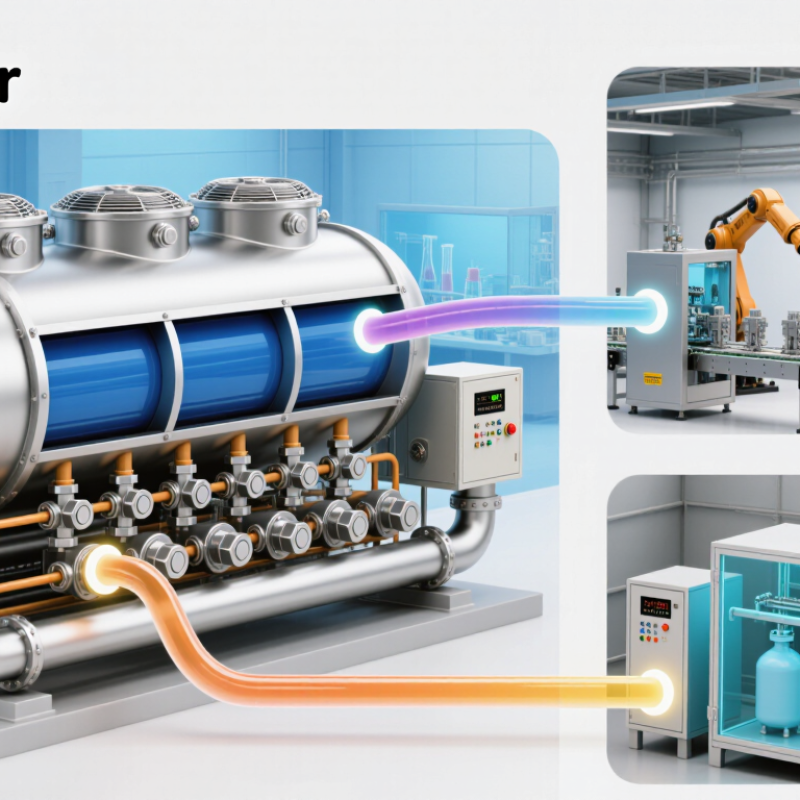
What a Cryo Chiller Is and How It Differs from Conventional Chillers
A cryo chiller is a refrigeration system designed to deliver temperatures far below those of typical process-water chillers. Depending on the application, it may cool fluids to tens of degrees below zero or lower. “Cryo” does not always mean the same temperature range. The term is used inconsistently.
A conventional chiller often supplies chilled water or glycol for equipment, molds, or building systems. Its setpoint may sit near 5–15°C. A cryo chiller instead uses components configured for much colder operation, such as staged refrigeration circuits, low-temperature heat exchangers, and enhanced insulation. These features help limit heat entering the process and support stable control. Think of a test vessel with a cold metal rim: even small heat leaks can affect the reading.
The difference matters in applications such as materials testing, freeze-drying, and specialized manufacturing. Very low temperatures can improve process control, but they also bring higher energy use, more demanding maintenance, and tighter requirements for fluid selection. Not every “cryo” task needs a cryo chiller. Engineers should confirm the required operating temperature, cooling load, and temperature stability before choosing equipment. A little uncertainty in the specification can become an expensive surprise.
How a Cryo Chiller Produces and Maintains Low Temperatures
A cryo chiller produces low temperatures by moving heat, not by “making cold.” In a vapor-compression loop, refrigerant evaporates at low pressure inside the evaporator and absorbs heat from the process fluid. That phase change does the work. The compressor raises refrigerant pressure; the condenser releases heat to air or cooling water; an expansion device lowers pressure for the next pass. For colder setpoints, some systems use two-stage or cascade circuits, splitting the temperature lift across separate cycles. A secondary fluid, often glycol or brine, carries cooling through insulated pipes to a reactor jacket, test chamber, or production coil. The achievable temperature depends on the system design and actual heat load.
Maintaining the setpoint is a control problem. Sensors track supply and return temperatures, while the controller adjusts compressor capacity and refrigerant flow. A buffer tank can soften sudden load changes; insulation limits heat entering the loop. Small things matter. A warm batch or low fluid flow can pull temperatures off target. Operators should also check fluid concentration, pump performance, and sensor calibration. These details are easy to miss. The IEA’s 2018 report, The Future of Cooling, projects global space-cooling energy demand to more than triple by 2050. The report concerns buildings, not process chillers, but it underscores the value of efficient heat removal.
Industrial Cooling Needs a Cryo Chiller Can Address
Why Choose a Cryo Chiller for Industrial Cooling?
Industrial Cooling Needs a Cryo Chiller Can Address
Some manufacturing processes need coolant below ordinary refrigeration temperatures. A cryo chiller can help control heat in applications such as specialty chemical production, laboratory testing, and precision material processing. Stable coolant temperatures may reduce batch variation and protect temperature-sensitive equipment. The fit depends on the required temperature range, heat load, and process tolerances—not simply on how cold the unit can run.
The U.S. Department of Energy’s 2022 Industrial Decarbonization Roadmap reports that industry accounts for about one-third of U.S. energy use. That figure is not specific to cooling, but it highlights why process efficiency deserves attention. A correctly sized chiller, paired with sound insulation and controls, can avoid needless cooling. Still, cryogenic systems may use more energy and require more careful maintenance than conventional chillers. Colder is not automatically better.
Tips: Record coolant supply and return temperatures, flow rate, and peak load before choosing a system. Check insulation around pipes and tanks; a cold pipe sweating in a warm room is a visible warning. Review operating data after installation, too. Real plants rarely behave exactly like design assumptions.
Key Benefits of Choosing a Cryo Chiller for Industrial Use
A cryo chiller can provide stable cooling for processes that need temperatures below the reach of standard industrial chillers. That matters. In a pilot plant, for example, a controlled coolant supply can help keep a reactor jacket near its set point as production conditions change. More consistent temperatures may reduce batch variation and protect temperature-sensitive materials.
Precise control is another practical benefit. Operators can monitor supply and return temperatures, then adjust settings when a process load shifts. This is useful for laboratory equipment, specialty manufacturing, and thermal testing. Yet the lowest possible temperature is not always the best target. Cooling capacity can fall as operating temperatures drop, so the required heat load and duty cycle should be checked before selecting equipment.
A properly integrated system can also support reliable operation across long production runs. Insulated piping helps limit unwanted heat gain, while suitable alarms can flag temperature drift or flow problems. Maintenance access matters too; filters, pumps, and connections should be easy to inspect. There is a trade-off, though: lower-temperature cooling may require more energy and careful setup. I would compare performance at the actual operating temperature, not rely only on a headline capacity figure.
Applications and Factors to Consider When Selecting a Cryo Chiller
Cryo chillers serve processes that need stable, below-zero temperatures, including semiconductor equipment, laser systems, freeze-drying, and laboratory test chambers. In practice, a cooling loop may need to hold a narrow temperature while heat loads rise and fall during a production cycle. Cold is only part of it. The International Energy Agency’s 2018 report, The Future of Cooling, estimates that cooling accounts for about 10% of global electricity use and could require more than three times as much electricity by 2050. That estimate covers cooling broadly, not cryo chillers alone, but it highlights why operating efficiency matters.
When selecting a unit, match its cooling capacity to the actual process load at the required temperature—not just its headline rating. Check temperature stability, flow rate, fluid compatibility, and performance at the site’s ambient conditions. A fluid that becomes more viscous when cold can reduce flow; exposed pipework can collect condensation or frost. Small details matter. Ask for performance data at your intended operating point, and consider part-load efficiency, maintenance access, heat rejection, and alarm functions. A chiller sized for peak demand may run inefficiently most of the year. Measure the real load. Pilot runs can help, although real production conditions may still reveal surprises.