
Why Does a Heavy Duty Truck Radiator Overheat?
Why Does a Heavy Duty Truck Radiator Overheat? The answer is rarely as simple as “the radiator is bad.” A temperature gauge climbing during a long haul can point to restricted airflow, low coolant, a failing pressure cap, or a thermostat that will not open. Sometimes, several small problems arrive together.
A clean-looking grille can hide packed bugs and dust between the condenser and radiator. Inside the system, rust or neglected coolant may narrow passages until heat has nowhere to go. “Overheating is a symptom, not a diagnosis,” says fictional cooling-system specialist Alex Morgan in this illustrative, original quotation. That distinction matters: replacing parts before checking the cause can waste money and leave the truck vulnerable on its next loaded climb. Details matter.
This guide examines the common reasons a Heavy duty truck radiator overheats and the checks that help narrow them down. It covers airflow, coolant circulation, pressure, fan operation, and maintenance habits. Drivers can note when the temperature rises, whether the cab heater blows warm air, and whether coolant levels keep dropping. Those observations can help a qualified technician find the fault. They are not a substitute for inspection, especially when steam, leaks, or a sudden temperature spike appear. One caution remains: symptoms overlap, and a single clue rarely proves the cause.
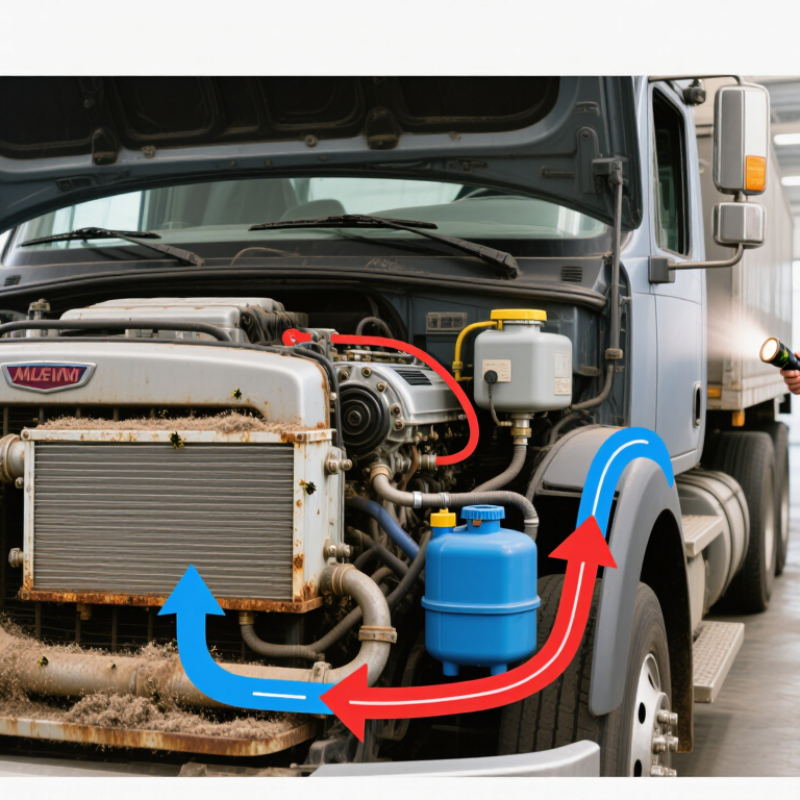
How a Heavy-Duty Truck Radiator Regulates Engine Temperature
A heavy-duty truck radiator is a heat exchanger: it helps move engine heat into the surrounding air. The water pump circulates coolant through passages in the engine, where it absorbs heat. When the engine is cold, the thermostat restricts flow to help it warm up. At operating temperature, the thermostat opens and sends hot coolant toward the radiator.
Inside the radiator, coolant travels through narrow tubes. Thin metal fins spread the heat across a larger surface, while airflow carries it away. The fan helps maintain airflow when the truck moves slowly or idles. Heat moves constantly. A pressure cap also raises the coolant’s boiling point, helping the system operate under demanding conditions.
Overheating occurs when heat builds faster than the system can shed it. Low coolant from a leak, a stuck thermostat, a worn water pump, or a failing fan can disrupt temperature control. Mud or debris packed against the fins may reduce airflow; scale inside the tubes can restrict coolant flow. A hot gauge reading does not always mean the radiator itself is faulty. Check the coolant level only when the engine is fully cool, and never remove a hot pressure cap. The diagnosis can be less obvious than the first guess.
Why Does a Heavy-Duty Truck Radiator Overheat?
How a Heavy-Duty Truck Radiator Regulates Engine Temperature
As engine load rises, coolant entering the radiator gets hotter. The radiator transfers heat to the surrounding air, so coolant leaving it is cooler. The thermostat and cooling fan help regulate this process. The values shown are an illustrative operating profile, not measurements or specifications for a particular truck; actual temperatures vary by engine and conditions.
Common Causes of Radiator Overheating in Heavy-Duty Trucks
Why Does a Heavy Duty Truck Radiator Overheat?
Common Causes of Radiator Overheating in Heavy-Duty Trucks
A heavy-duty radiator can overheat when heat cannot move through the cooling system fast enough. Low coolant is a common clue, but the leak may be hard to spot. Check hose joints, the water pump seal, and dried coolant around the radiator. Even a small leak can admit air and interrupt circulation. Small leaks matter.
A blocked radiator is another frequent cause. Road dust, insects, and bent fins restrict airflow; internal scale can restrict coolant flow. A fan clutch that slips may also fail to pull enough air through the core during slow climbs or long idling. The U.S. Department of Energy’s Alternative Fuels Data Center describes water-glycol blends as a standard cooling approach. A 50:50 mixture is common, but the correct mix depends on the truck’s service requirements. ASTM D6210 sets performance requirements for fully formulated glycol coolant in heavy-duty engines; it does not make neglected coolant harmless.
A stuck thermostat, worn pump impeller, or faulty pressure cap can produce similar symptoms. Don’t assume a rising gauge means the radiator alone is at fault. Check coolant level only when the engine is cool, then inspect the cap, belts, fan operation, and airflow. A gauge sender can misread, too. That clue is easy to miss. Follow the vehicle service manual and use the specified coolant; mixing incompatible fluids can reduce protection.
Warning Signs of a Truck Cooling System Problem
A heavy-duty truck radiator problem often announces itself before the temperature gauge reaches the red zone. Watch for a steadily climbing gauge, a coolant warning light, or steam drifting from beneath the hood. These signs deserve attention. A sweet coolant smell, damp spots under the truck, or dried residue near hose connections can also indicate a leak. Not always.
Cooling trouble can show up under load. The temperature may rise while climbing a long grade, hauling a heavy trailer, or idling in traffic, then drop when the truck slows. That pattern can point to restricted airflow, a weak fan, low coolant, or a clogged radiator. It is not a diagnosis by itself. A loose belt or faulty thermostat may produce similar symptoms, so note when the gauge changes and have the system inspected. If steam appears or the gauge enters the danger zone, pull over safely and shut the engine off. Never open a hot radiator cap; pressurized coolant can cause severe burns.
Tips: Check the coolant level only when the engine is cool, and look for wet hoses, damaged fins, or debris blocking the grille. Keep a simple record of temperature changes, load, and warning lights. Small details help a technician trace the fault. I used to assume a clean-looking radiator was fine; that was a poor shortcut. Airflow and internal restrictions are harder to judge by sight.
Why Does a Heavy Duty Truck Radiator Overheat? - Warning Signs of a Truck Cooling System Problem
| Warning Sign | Possible Cooling-System Causes | What to Check | Recommended Response |
|---|---|---|---|
| Coolant temperature rises above the normal operating range, especially under load or while climbing | Restricted radiator airflow, debris between the radiator and charge-air cooler, a slipping fan drive, low coolant, or internal radiator blockage | Check the temperature reading against the vehicle’s normal range; inspect the radiator face and nearby heat exchangers for dirt, damage, or blocked airflow | Reduce engine load and stop safely if the temperature continues to rise. Arrange a cooling-system inspection before returning to heavy operation |
| Temperature rises in traffic or at low speed but improves at road speed | Cooling fan, fan clutch, fan control, or airflow-shroud problem | Have fan operation and control signals checked according to the vehicle service procedure; look for damaged or missing shroud sections | Do not reach near a fan. A fan may start unexpectedly; have the fan system inspected by a qualified technician |
| Coolant level repeatedly drops or a puddle appears beneath the truck | Leak from a hose, clamp, radiator, water pump, expansion tank, heater circuit, or other cooling-system connection | With the engine cool, inspect the reservoir level and look for wet areas, dried coolant residue, or damaged hoses | Do not remove a pressurized cap while hot. Repair the leak and refill with the specified coolant mixture before operation |
| Steam, a strong coolant odor, or coolant discharge from the pressure-relief area | Overheating, excessive system pressure, a faulty pressure cap, coolant loss, or a combustion-gas leak | Stop safely and allow the engine to cool. Once cool, check the coolant level and have the cap and system pressure-tested | Stop the engine if it is overheating or venting steam. Keep clear of hot coolant and do not open the cap until fully cool |
| Temperature fluctuates, or cabin heat becomes weak while the engine temperature rises | Low coolant, air trapped in the system, a thermostat problem, or reduced coolant circulation | After the engine cools, check the coolant level and inspect for leaks; ask a technician to verify thermostat operation and proper bleeding | Avoid continued operation with unstable temperature. Use the vehicle-specific filling and bleeding procedure after repairs |
| Coolant looks rusty, cloudy, oily, or contains visible particles | Corrosion, incompatible or degraded coolant, contamination, or possible oil or combustion-gas entry | Have the coolant condition and system tested; inspect for contamination sources and verify the coolant specification | Correct the underlying cause before flushing and refilling. Use coolant that meets the engine manufacturer’s requirements |
| Radiator fins are bent, clogged, or coated with dirt, insects, or debris | Reduced heat transfer from restricted airflow or damaged cooling fins | Inspect the radiator and adjacent coolers from the safe side; check for bent fins, external blockage, and restricted air passages | Clean using an appropriate method that will not fold the fins or damage the core; seek professional cleaning if access is limited |
| Repeated overheating after coolant has been topped up | Unresolved leak, blocked radiator, failing water pump, thermostat fault, fan-system issue, or internal engine problem | Request a systematic inspection that may include pressure testing, fan checks, thermostat and pump evaluation, and tests for combustion gases | Do not keep driving an overheating truck. Continued overheating can cause severe engine damage |
How to Diagnose Radiator Overheating
When a heavy-duty truck overheats, diagnose the temperature pattern before replacing parts. Check the gauge against an infrared reading at the thermostat housing, then inspect coolant level, leaks, and the radiator cap. Never remove a hot cap. SAE J1034 and ASTM D6210 specify requirements for heavy-duty engine coolant. A 50/50 ethylene-glycol mixture boils at roughly 226°F without pressure and around 265°F under a 15-psi cap, according to published coolant property data. A weak cap can lower that margin. Look for dried coolant around the neck.
Next, compare temperatures across the radiator core. Cold bands may indicate restricted tubes; uniformly hot surfaces with rising engine temperature can point to poor airflow or a slipping fan drive. Check for debris packed between the condenser and radiator, bent fins, and a fan clutch that fails to engage. Under load, record coolant temperature, ambient temperature, and fan operation; one idle test may miss a fault that appears on a long grade. A borderline reading can still mislead. Verify the thermostat opens and confirm the water pump moves coolant before flushing the system. Small details matter. Keep the readings; they make the next diagnosis less dependent on guesswork.
Maintenance Practices That Help Prevent Overheating
Why Does a Heavy Duty Truck Radiator Overheat?
Maintenance Practices That Help Prevent Overheating
A radiator often gives warning before temperature climbs: dried coolant marks, bent fins, or a slowly dropping reservoir level. Check coolant level only when the engine is cool, and inspect hoses for soft spots, swelling, or rub marks. Small leaks matter. A 50/50 ethylene-glycol coolant mixture typically protects to about −34°F (−37°C); the exact protection depends on the coolant and water quality. ASTM D6210 specifies performance requirements for fully formulated heavy-duty engine coolant, so verify the product meets the engine maker’s specification. Do not judge coolant by color alone.
Keep the radiator face clear of bugs, dust, and chaff; clean it gently to avoid folding the fins. Inspect the fan, belt tension, pressure cap, and thermostats during scheduled service. A cap that cannot hold pressure can lower the coolant’s boiling margin. Follow a coolant-testing plan, too: Technology & Maintenance Council guidance on coolant analysis emphasizes checking freeze point, pH, and inhibitor condition. Record results over time. One sample can mislead. If temperatures rise under load, note the route, ambient heat, and gauge behavior before replacing parts; a partially blocked core or faulty gauge can look similar. Regular checks help, but they cannot compensate for neglected repairs.


